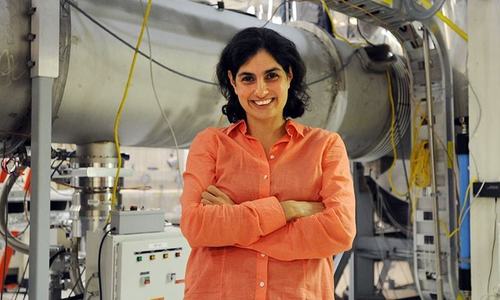
Astrophysicist Dr Nergis Mavalvala explains how scientists ‘listen’ to the universe
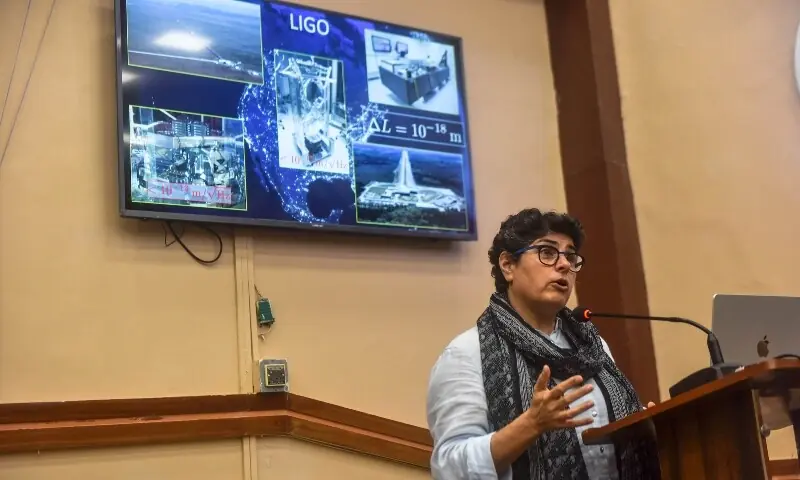

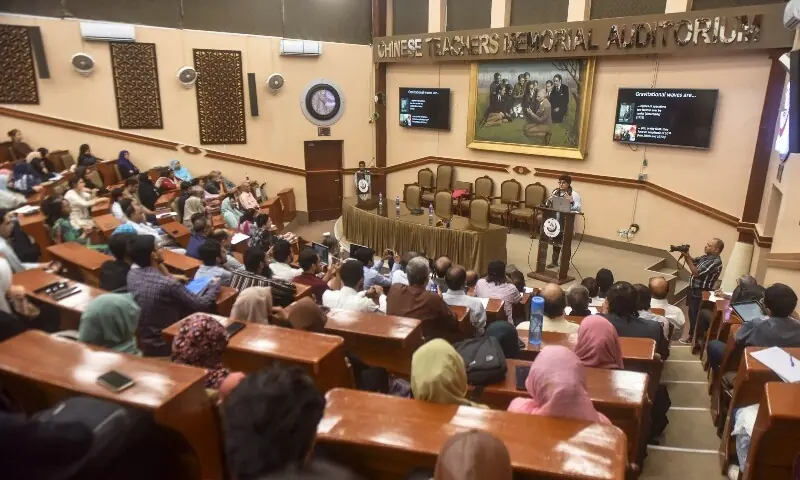
KARACHI: The Chinese Teachers Memorial Auditorium at the University of Karachi was packed to capacity on Tuesday as students and faculty members from science and other disciplines gathered to hear Prof Dr Nergis Mavalvala, a Pakistani-American astrophysicist who grew up and received her early education in Karachi before moving to the United States, where she went on to become dean of the School of Science at the Massachusetts Institute of Technology.
For many in the audience, her return to the city was an opportunity to hear first-hand from a scientist whose childhood interest in science, electronics and repairing things eventually led her to the forefront of research into some of the most mysterious phenomena in the universe.
Prof Mavalvala is best known for her work on the detection of gravitational waves through the Laser Interferometer Gravitational-Wave Observatory (LIGO) project. Her research has also focused on exploring macroscopic quantum effects, including quantum squeezing in optomechanics.
At KU, she delivered a special lecture titled ‘Listening to the Universe Above the Quantum Din’, organised under the Distinguished Lecture Series by the Office of Research, Innovation and Commercialisation in collaboration with the Department of Physics and the Institute of Space Science and Technology.
Dean of MIT School of Science Dr Nergis Mavalvala delivers lecture at KU
The lecture offered students and researchers an opportunity to understand how a relatively new field of gravitational-wave astronomy is changing the way scientists study the universe.
By explaining the science behind LIGO and the detection of gravitational waves, Prof Mavalvala also sought to give students a glimpse into the research, technology and questions driving some of the most ambitious experiments in modern physics.
Its primary focus was that for most of us, the universe is something we experience through what we can see — the stars, planets and distant galaxies captured by telescopes. But some of the most extraordinary events in the cosmos cannot be seen at all. When massive objects such as black holes collide, they send faint ripples through the fabric of space and time, travelling across billions of light-years before reaching Earth.
Detecting these ripples requires instruments capable of measuring changes far smaller than anything perceptible to humans. Prof Mavalvala explained how decades of research turned Einstein’s prediction of these ripples — known as gravitational waves — into something scientists could actually detect.
She explained that according to Einstein, gravity is not merely a force but rather the result of the curvature of space and time. Massive bodies bend the fabric of spacetime around them, causing other objects to move under their influence. The motion or vibration of a massive astronomical body can generate ripples in spacetime, known as gravitational waves. Although Einstein had theoretically predicted their existence, their extreme weakness made direct measurement a formidable challenge for scientists over many decades.
She stated that the observation and study of black holes and neutron stars provided a new dimension to gravitational wave research, since these extremely dense celestial objects, when orbiting one another, can emit powerful gravitational waves.
Referring to the contributions of her PhD supervisor and eminent scientist Prof Rainer Weiss, she noted that in the 1970s he proposed the concept of highly sensitive detectors capable of measuring minute variations, which later became the foundation of modern gravitational wave detection systems.
She then elaborated on the establishment of LIGO and its fundamental scientific principle, explaining that the project’s aim is to record the tiniest distortions in spacetime caused by gravitational waves through highly sensitive interferometers. For this purpose, detector arms were extended over several kilometres to make even the slightest changes measurable.
She emphasised that the distortions produced by gravitational waves are so minuscule that their scale is beyond human imagination. At LIGO, Lshaped interferometers approximately four kilometres long, combined with ultrasensitive laser systems, detect the smallest possible shifts in the distances between mirrors. The two LIGO observatories located in Washington and Louisiana employ stateoftheart scientific technology for this purpose.
Prof Mavalvala highlighted that LIGO’s remarkable scientific achievement lies in its ability to sense and measure unimaginably minute changes in spacetime despite environmental vibrations, noise and other interferences.
“LIGO uses highly stable, lownoise lasers with a wavelength of 1,064 nanometres, and that averaging measurements from large numbers of photons further enhances accuracy. The combination of these technical systems has placed LIGO among the world’s most sensitive gravitational wave detectors,” she said.
She emphasised that this global scientific journey of gravitational wave measurement is the outcome of decades of research, experimentation, and persistent effort, beginning with the pioneering work of Prof Weiss and other scientists in the 1970s.
Ultimately, in 2015, scientists succeeded in recording direct signals of gravitational waves for the first time, marking a historic milestone in modern physics and opening a new path for studying the most powerful cosmic events in the universe.
Prof Mavalvala clarified that when black holes and neutron stars orbit one another, they emit gravitational waves through which orbital energy is continuously radiated. As a result, these celestial bodies gradually draw closer until they eventually collide and merge.
She reported that through LIGO, the merger of two black holes approximately 1.2 billion lightyears away was observed, each with a mass nearly 30 times greater than that of the Sun.
According to her, as the two black holes approach each other, their orbital speed, the frequency of gravitational waves and their intensity steadily increase, while at the precise moment of merger the gravitational wave signal reaches its maximum strength.
She concluded that observing gravitational waves has given scientists a unique way of studying those immensely powerful cosmic events that cannot be directly seen through conventional telescopes. “This research is playing a vital role in deepening our understanding of the universe, black holes, neutron stars, and the fundamental structure of spacetime itself,” she added.
Published in Dawn, September 23rd, 2026