
PESHAWAR: The Khyber Pakhtunkhwa government on Wednesday approved a proposed law to replace the KP Police Act, 2017, in a move to rein in the inspector general of police.
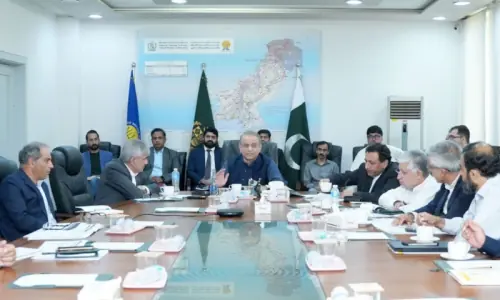
The KP Police Act, 2026, will link the police chief’s operational, administrative and financial decisions to the approval of the provincial government or the chief minister for implementation, according to the draft okayed by the provincial cabinet during a meeting chaired by Chief Minister Sohail Afridi here.
“The administration of police in the province shall vest in the provincial police officer, who shall exercise such operational, financial and administrative powers subject to policy given by the police policy board and directions issued by government or the chief minister,” the draft said.
The proposed law, approved by the cabinet here in a meeting chaired by Chief Minister Sohail Afridi, also said the provincial government could initiate a case of premature transfer of the provincial police officer over unsatisfactory performance.
Draft says police chief’s decisions will require govt’s nod for implementation
It added that the provincial government might, with the approval of the federal government, repatriate or the federal government may, on its own accord, recall the provincial police officer.
“If the government is not satisfied with the PPO’s performance, it may take up the matter with the federal government for his repatriation and request to provide a list of three senior police officers not below the rank of BPS-21 for appointment of one of them as PPO.
“The government shall, out of a panel, post a police officer as provincial police officer of the province. In case the government doesn’t agree with the list of names, it shall be returned with a request to provide another panel.”
The proposed law said the posting and transfers in the police establishment would be made by the PPO, including that of regional and district police officers, with the approval of the chief minister.
During the cabinet meeting, the chief minister said that some plainclothes men had been targeting PTI workers, organisational office-bearers and elected representatives.
He said that an attempt was made on the life of minister for communications and works Shakeel Khan, while a bid to kidnap him was foiled.
Mr Afridi said that some plainclothes men also reached the house of minister for irrigation Riaz Khan, while in Dera Ismail Khan and other districts, too, PTI workers and elected representatives were being treated the same way.
He said that MNA Fazal Khan was abducted, while unidentified individuals also stormed MPA Fakhr Jahan’s house.
The chief minister said that elected representatives and ministers were on target. He questioned that if the cabinet ministers were unsafe , what would be the condition of the rest of the country.
“These people are scared of the power of the people,” he said, adding that such treatment of the members of the provincial cabinet was unacceptable.
The chief minister said that KP would be cut off from the rest of Pakistan due to the closure of all ways to it but all other parts of the country would remain open.
He wondered whether a conspiracy was in the works.
“Is an attempt being made to repeat a tragedy like that of East Pakistan? We have a clear message for anyone who conspires to divide Pakistan or separate KP from Pakistan that Pakistan is ours,” he said.
The chief minister said if his government was forcing the local bureaucracy, police, DCs and DPOs to do anything wrong, then they should not obey those orders. He said that the Constitution allowed peaceful protests, so the PTI would take to the streets at all costs.
Mr Afridi said as long as the right to peaceful protest existed in the Constitution, the PTI would continue exercising it.
He urged people in the province and other parts of the country neither to panic nor to be afraid.
Later, a statement issued from the office of information minister Shafi Jan said that the proposed legislation regarding the police chief would also introduce greater institutional accountability in police postings and transfers, particularly with regard to the appointment and transfer of regional and district police officers under the Khyber Pakhtunkhwa Rules of Business, 1985.
The minister said that the move would introduce a clear separation between the policy and operational streams of policing through the establishment of two distinct institutional forums, including the Police Policy Board to be headed by the chief minister and the Police Operations Board to be headed by the PPO.
“The PPO will also be required to prepare and present an annual policing plan before the Police Policy Board for consideration and approval. The annual policing plan will provide a structured framework for policing priorities, performance and institutional objectives, subject to approval by the Police Policy Board,” he said.
The minister said the proposed law would introduce a clear and comprehensive mechanism for the functioning of dispute resolution councils across the province, addressing the existing gap in the legal framework.
“To ensure greater transparency, accountability and uniformity, all existing DRCs would be dissolved and reconstituted afresh in accordance with the provisions of the new law,” he said.
Published in Dawn, September 24th, 2026