Federal Constitutional Court rejects inheritance claim by children of predeceased brother
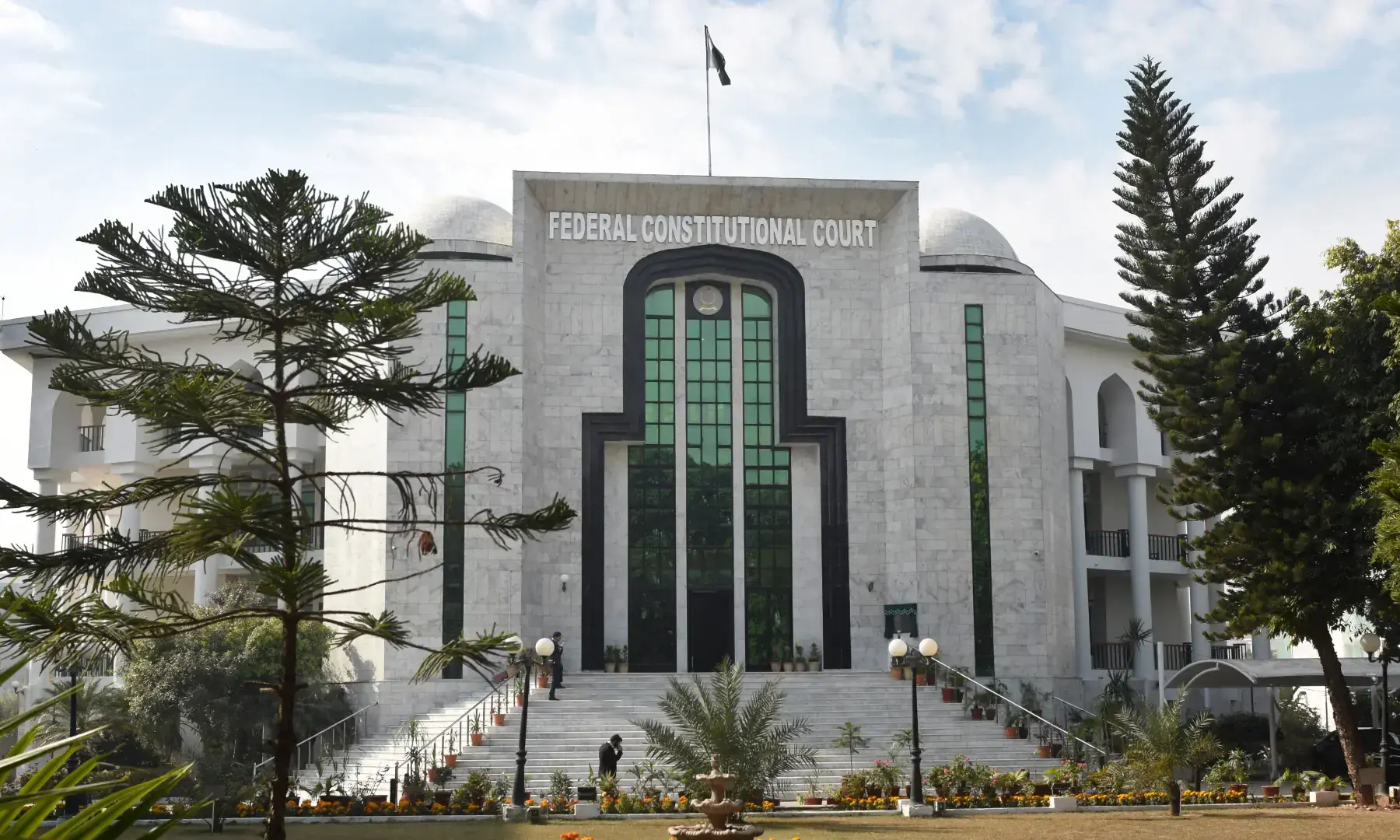

ISLAMABAD: The Federal Constitutional Court (FCC) on Thursday rejected a plea seeking inheritance rights in the property of an issueless deceased man, ruling that the children of a predeceased brother cannot invoke Section 4 of the Muslim Family Laws Ordinance, 1961, to claim a share in the property.
“Section 4 of the Muslim Family Laws Ordinance, 1961 is attracted only where the predeceased heir is a son or daughter of the propositus (central person from whom a family tree’s lineage is traced) and the claim is made by the children of such son or daughter,” observed Chief Justice FCC Aminuddin Khan, who headed a two-judge FCC bench.
The bench, also comprising Justice Ali Baqar Najafi, had taken up a challenge to the March 18, 2026, Lahore High Court (LHC) rejection of a similar plea. The petition was moved by Javed Iqbal Rana (deceased) through his legal heirs against Abdul Waheed Rana, also deceased.
“Succession is a matter governed by law and neither sentiment nor perceived hardship can furnish a basis for creating an heir where the governing law does not recognise one,” said the 15-page judgment authored by the chief justice.
Section 4 of the Muslim Family Laws Ordinance does not extend, either expressly or by analogy, to the children of a predeceased brother of the propositus, the judgment explained, adding that the petitioners, consequently could not derive a right of inheritance from Section 4.
The dispute involves succession to property No. 15-L, Model Town Extension, Lahore, owned by Ijaz Ahmed Rana, who died issueless on Dec 31, 2018. The petitioners, Javed Iqbal Rana (deceased) through his legal heirs, claimed to be the sons of the predeceased brother of the deceased and asserted a right of inheritance under Muhammadan Law.
The petitioners alleged that although they were initially impleaded as defendants in a suit for declaration, their names were subsequently deleted from the array of parties through an amended plaint without their knowledge, following which the suit culminated in an ex-parte decree.
The controversy, the FCC noted, lay within a narrow compass, namely, whether, by virtue of their relationship with the deceased, the petitioners could invoke Section 4 of the ordinance to claim a right of inheritance in his estate.
The answer to this question must necessarily be found in the plain language of the provision and the legislative scheme embodied therein, the judgment said.
The petitioners, the judgment explained, were neither the children of a predeceased son nor of a predeceased daughter of the propositus, rather, they were the children of his predeceased brother.
“However, the critical point for present purposes is that no collateral descendant can claim under the principle of Tanzil (substitution/representation) in classical Hanafi law.”
There is also a fundamental distinction between statutory succession under Section 4 and the classical Muslim law of inheritance. Under the traditional Sunni law of inheritance, the estate of a Muslim devolves upon those heirs who are alive at the moment succession opens, according to their respective categories and rules of exclusion, the judgment observed.
A predeceased brother does not transmit a prospective inheritance in the estate of his brother to his children merely because he would have been related to the propositus had he survived him. The children of such a collateral relative cannot, therefore, claim to inherit by simply stepping into the position of their deceased father unless a positive rule of law creates such representation, the judgment said.
In the classical Hanafi scheme, the son of a full brother is recognised in the category of residuaries in appropriate circumstances, whereas descendants of certain female collateral relatives fall within the category of distant kindred.
Their entitlement, however, depends upon the existence or absence of nearer sharers and residuaries and cannot be created merely by analogy with Section 4.
Published in Dawn, September 25th, 2026