Indian strategy threatens South Asian security: experts

• Call for a broader understanding of strategic stability beyond military power
• SPD official links India’s strategic approach to Hindutva nationalism
GILGIT: A senior Strategic Plans Division (SPD) official has said that India’s strategic behaviour was undermining security in South Asia, as experts called for a broader understanding of regional stability amid rapid military and technological changes.
Retired Maj Gen Syed Shahab Shahid, who is director general of Arms Control and Disarmament Affairs at the SPD, said the present Indian leadership was driven by an ultra-nationalist Hindutva philosophy that had produced a dangerous sense of exceptionalism and superiority, resulting in the “jeopardisation of South Asian security calculus”.
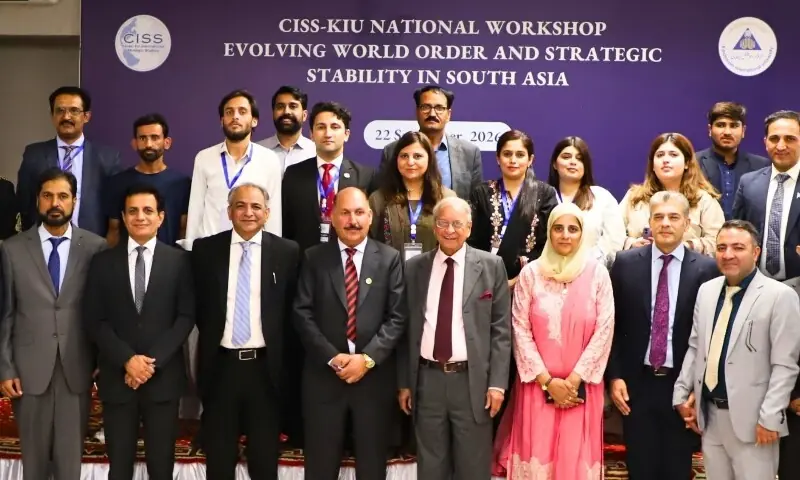
Mr Shahid was speaking at a one-day national workshop on ‘Evolving World Order and Strategic Stability in South Asia’, organised by the Centre for International Strategic Studies (CISS), Islamabad, in collaboration with Karakoram International University, Gilgit.
The workshop brought together policymakers, senior military officials, diplomats, strategic experts and academics to examine changes in the international strategic environment and their implications for the nuclear order, arms control, strategic stability, emerging technologies and security dynamics in South Asia.
In his opening remarks, CISS Executive Director Ambassador Ali Sarwar Naqvi said the changing international environment and growing challenges to global arms control and nuclear governance required a broader approach to strategic stability.
“Understanding strategic stability in the twenty-first century requires us to look beyond traditional measures of military power,” Mr Naqvi said.
The discussions came against the backdrop of the expiry of the New START Treaty and the absence of a bilateral arms control arrangement between the major nuclear powers. Speakers also examined India’s military modernisation and changing force posture and their implications for strategic stability in South Asia.
A session on the strategic environment in South Asia focused on Indian strategic behaviour and strategic culture, as well as lessons from the trajectory of India-Pakistan crises from Pulwama to Pahalgam.
Retired Brig Dr Zahirul Haider Kazmi, adviser on arms control, discussed lessons for strategic stability from the trajectory of India-Pakistan crises in a recorded message.
CISS Director Research Dr Bilal Zubair examined the impact of emerging technologies on future conflicts in South Asia, highlighting another dimension of the changing strategic environment. The discussions focused on how technological developments could affect deterrence, escalation and crisis management beyond traditional military capabilities.
Published in Dawn, September 25th, 2026