1.Manga magazines can be really thick
In Japan, manga is often first published in large magazines that contain chapters from many different series. So, instead of buying one book with one story, readers pick up a single magazine and find lots of different manga inside it. Some of these magazines can be hundreds of pages long.
2. Manga has a “smell” category
There are manga created around food, cooking and eating. In these, the food itself becomes a major part of the story. Some artists spend a surprising amount of time making dishes look so realistic that readers can almost imagine the taste and smell.
3. Some manga series just don’t stop
Golgo 13 began in 1968. It holds the Guinness World Record for the most volumes published for a single manga series. The series reached 201 volumes by 2021 and is still being serialised.
4. Manga artists don’t always draw everything themselves
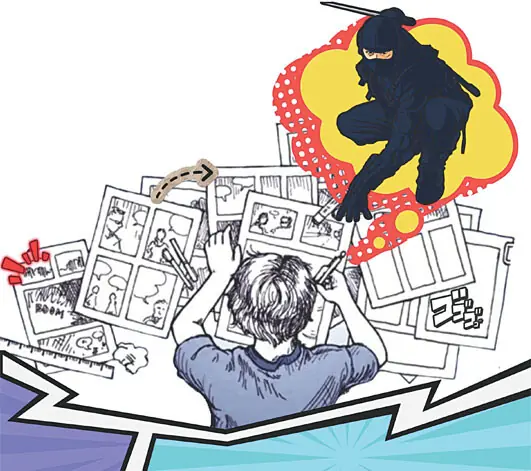
Manga artists are called mangaka. Most professional mangaka work with assistants, with the main artist focusing on the characters and story while assistants work on backgrounds, shading and other small details.
5. Japanese onomatopoeia:
Onomatopoeia is the use of thousands of expressive words that mimic not only real-world sounds, but also physical textures, movements, emotional states and silent conditions. In English, words like ‘Bang!’, ‘Crash!’ or ‘Pow!’ are used to imitate sounds or describe the impact of an action. Similarly, onomatopoeia is extensively used in manga, to portray psychological states, like doki-doki for a fast-beating heart or even shiin to visually represent total, uncomfortable silence.
Japanese has thousands of these words, with estimates ranging from 1,200 to over 4,500, and they are commonly used in everyday conversation. Then they are generally split into four main categories: Giseigo: sounds made by living creatures, (e.g., wan-wan for a dog barking).
Giongo: sounds made by inanimate objects or nature, such as rain or a ticking clock (e.g., zaa-zaa for heavy rain).
Gitaigo: words that describe a physical state, condition or appearance that does not actually make a sound, such as kira-kira (glittering/sparkling).
Gijougo: words that describe internal feelings and emotions, such as waku-waku (feeling excited/anticipation.
Published in Dawn, Young World, September 26th, 2026