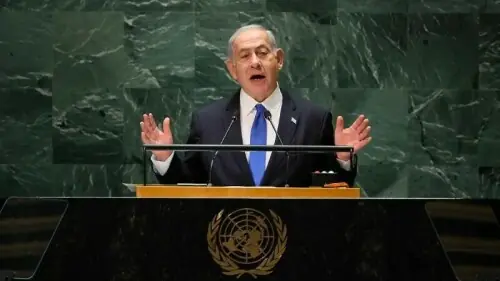
WASHINGTON: The most striking feature of Israeli Prime Minister Benjamin Netanyahu’s appearance in New York this week was not simply the hundreds of protesters outside the United Nations, or the diplomats who walked out when he began speaking; it was the people standing outside.
They included Palestinians and other Muslims, but also Jews, Christians, secular Americans, professors, artists and young activists, who all said they could no longer remain silent about the destruction in Gaza.
Something fundamental appears to be changing in America. Younger Americans increasingly view Israel and the Palestinians differently from their parents and grandparents.
A Pew Research Center survey conducted in May found that only 18pc of Americans aged 18 to 29 had a favourable view of the Israeli government, compared with 47pc among those aged 65 and older. By contrast, 58pc of the youngest Americans had a favourable view of Palestinians, compared with 47pc among those 65 and older.
Devastating images from Gaza are reshaping young people’s views of Israel
However, only 13pc of young adults view Hamas favourably. That distinction is important because the polling shows that many younger Americans increasingly distinguish between Palestinians and Hamas, while becoming more critical of the Israeli government.
Shibley Telhami, a University of Maryland political scientist, notes that the images confronting younger Americans are vastly different from those that shaped earlier generations.
Older Americans came of age with memories of Israel’s creation after Holocaust and its early wars. Younger Americans have grown up watching Gaza on their phones — dead children, displaced families and destroyed neighbourhoods. For many, Gaza has become a formative political experience.
The shift is also visible among American Jews. Pew found in 2026 that 83pc of Jewish Americans viewed the Israeli people favourably, while 47pc expressed a favourable view of the Israeli government.
The relationship between Israel, its government and American Jewish identity is being debated more openly.
That debate was visible on the streets of New York. Manijeh Moradian, a professor of Iranian and Jewish heritage, told reporters the destruction of Gaza was being carried out “in our name, with our tax dollars” and that people had a responsibility to speak out.
Jewish organisations also held demonstrations near the UN. Groups including T’ruah, J Street, the New Israel Fund, the New York Jewish Agenda and Partners for Progressive Israel criticised Netanyahu’s government. At another protest organised by Jewish Voice for Peace, police arrested more than 100 people.
Some protesters identify with liberal Zionism; others reject Zionism entirely. But they share opposition to Netanyahu’s government and the conflict in Gaza.
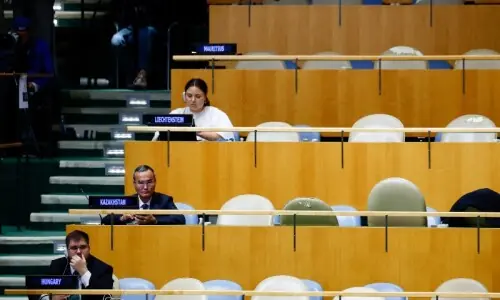
Inside the UN, dozens of delegations walked out as Netanyahu began speaking.
The prime minister defended Israel’s military campaign, rejected allegations of genocide and accused his critics of hypocrisy. He also turned his attention to New York Mayor Zohran Mamdani, whom he accused of antisemitism and spreading falsehoods.
Mamdani responded after the speech, accusing Netanyahu of repeating “baseless lies meant to sanitise his genocide of Palestinians”. He added that Netanyahu remained the subject of an International Criminal Court arrest warrant alleging war crimes and crimes against humanity.
Shortly before Netanyahu’s speech, Mamdani planted an olive tree at Gracie Mansion with Palestinian families from Gaza.
“May peace be our future,” he wrote alongside a video of the ceremony. The gesture, occurring as Netanyahu addressed the UN and attacked him by name, offered a starkly different image of how the Gaza tragedy was being remembered in New York.
The exchange illustrated a larger change. Israel’s relationship with America is no longer debated only in terms of its security or right to exist. Increasingly, especially among younger Americans, the question is what Israel is doing now.
While the generational divide is not absolute and attitudes remain sharply divided by party and ideology, the age gap is clear.
For a generation growing up with Gaza on its screens, Israel is being judged not primarily by the history that shaped their parents’ views, but by the images and events shaping their own lives.
Published in Dawn, September 26th, 2026