Viewing the universe from the shoulders of giants
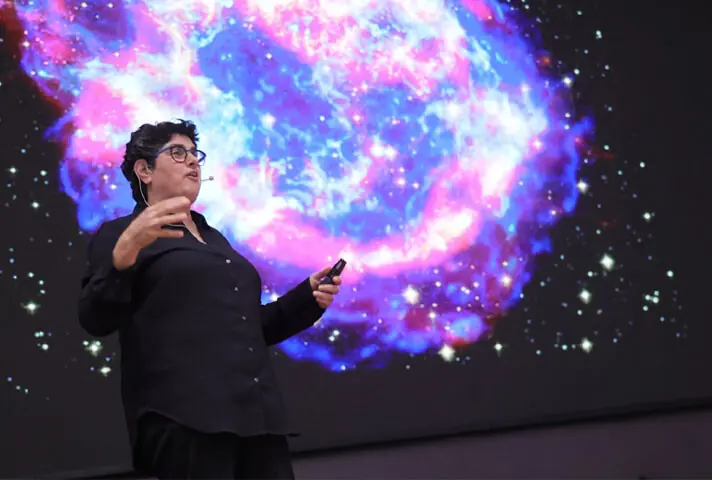

KARACHI: At Habib University’s 10th Yohsin Lecture on Friday, the globally acclaimed astrophysicist and dean of the School of Science at the Massachusetts Institute of Technology (MIT) Dr Nergis Mavalvala explored ‘The Joy of Discovery: Curiosity, Science and the Pivotal Role of Universities’.
While welcoming the Karachi-born and raised professor of astrophysics, Habib University’s founding President Wasif Rizvi said that her city has been tracking her with very fond admiration. “Our instruments are less refined than yours, mainly consisting of newspaper reports and WhatsApp groups, but the signal came through clear on that morning of Feb 11, 2016 when the world learned about the US-based LIGO Scientific Collaboration where you and your colleagues made that historic detection of the gravitational waves. And then again a few years ago when the Massachusetts Institute of Technology asked you to lead its School of Science as the first woman dean in its history,” he said.
Starting her lecture, Dr Mavalvala said that humans have been looking at the sky forever because it represents mystery. “There was a paradigm shift in the 1600s when Galileo became the first person to point a telescope at the sky. It allowed humans for the first time to not just see things with the naked eye but to use instrumentation to do it. As the years passed, we have built more and more sophisticated telescopes and giant observatories,” she said.
“We live here on Earth. The Earth is a planet that orbits the sun. The sun is a star that is one of a hundred billion stars in our galaxy, the Milky Way. The Milky Way is one of billions of galaxies in the universe. And so the universe is very vast and we, using gravitational waves, have opened a new window into the universe,” she said.
MIT Professor Mavalvala says Galileo’s toy-like telescope led to a paradigm shift in astronomy
The MIT professor said: “In 2015, somewhere in the universe two black holes collide. These two black holes had set out on a journey of 1.2 billion light years. When the gravitational waves of the collision came through, they were detected by us. We had one detector in Washington and one in Louisiana and they both saw the same signal.”
“There has never been any discovery in science that did not turn into the technology of 10 to 50 or 100 years later. That is the reason that science is worth doing,” she added.
“Galileo’s telescope was about one-and-a-half inches. More toy store telescopes are more powerful than that. Since Galileo, we have built 100-inch telescopes on Earth, we have built 100-inch telescopes in space. We are now building 25 to 30-metre telescopes here on Earth, we have infrared telescopes, X-ray telescopes, radio telescopes. It took 400 years to do that and we put together a more complete picture of our universe because of that one paradigm shift that an unimpressive telescope, by today’s standards, did,” she pointed out.
“In January 2025, almost 10 years after we detected the gravitational waves, we saw a system that was almost identical which was the same 1.2 billion light years away but the instruments that we were using had improved by a factor of three, which allowed us to work with more precision. So we now know that the black holes are not just orbiting each other but they are also spinning on their own axis,” Dr Mavalvala said.
“Today, we are at a moment where we have birthed a field and in a hundred years that is not what will be but they are also spinning on their own axis,” Dr Mavalvala said.
“Today, we are at a moment where we have birthed a field and in a hundred years that is not what will be remembered. The only thing that will matter is that we have turned out a completely new vein to observe the universe because for the first time we don’t need light. We can use gravitation to observe the universe and that is the change that we have made,” she added.
“So it took a hundred years to open this new window into the universe after Albert Einstein had told us that it is there to be had. In that process we have come up with dozens of new technologies, we have trained thousands of scientists and engineers, involved many students of science and over 400 universities and institutions from different countries. They were an engine for discovery, generating fundamental knowledge while cultivating science,” the professor of astrophysics concluded.
Published in Dawn, September 26th, 2026