China surge, Japan’s home heroes and Asian Games chaos on day of records

NAGOYA: China’s gold rush continued at the Asian Games on Saturday as the continental showpiece passed the halfway mark, while hosts Japan celebrated marathon triumphs and an 11-year-old esports champion amid renewed scrutiny over sparse crowds and logistical problems.
China powered beyond the 100-gold mark in Nagoya, underlining the depth of its sporting programme. Its athletes added titles in shooting, canoe sprint and diving, among other events, with Wang Nan retaining the women’s kayak single 500m title and Han Jiayu claiming her third gold of the Games in the women’s 50m rifle three positions.
China also made a winning start to the diving competition, taking gold in both the women’s synchronised 10m platform and men’s synchronised 3m springboard.
Japan, meanwhile, found some of its most memorable moments on home soil.
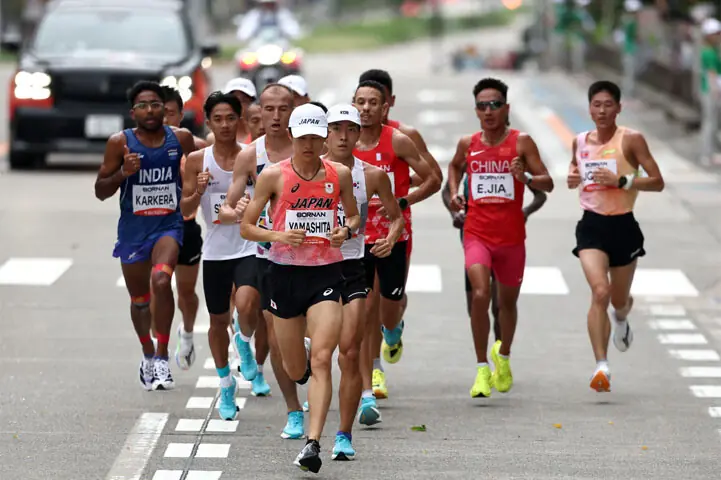
Ichitaka Yamashita delivered the hosts’ seventh men’s Asian Games marathon title, timing 2 hours, 10 minutes and 49 seconds in wet conditions. The Nagasaki native stayed out of the early work before making his decisive move with 10 kilometres remaining, pulling clear as North Korea’s Han Il Ryong and India’s Sawan Barwal began to fade. Barwal took silver in a personal best, while China’s Feng Peiyou secured bronze.
The women’s marathon produced another veteran success, with Bahrain’s 36-year-old Shitaye Eshete claiming gold 16 years after winning a 10,000m bronze at the Guangzhou Games. Eshete held off China’s Ciren Cuomu and Japan’s Mikuni Yada, who took silver and bronze respectively.
Eshete said she was considering retirement but hoped to compete at the 2027 world championships. The mother of three said her son had asked her not to run because he wanted her at home, but added that he would be happy with her latest gold medal.
Japan’s other feel-good story came from 11-year-old Yuki Kurihara, believed to be the youngest competitor at the Games. The schoolboy won gold in the Puyo Puyo Champions esports competition, recovering from a game down to beat South Korea’s Kang Dong Shin 10-2.
Kurihara, who says he eats eel before competitions, admitted he felt embarrassed by the attention but was delighted with his medal. “The gold medal is really beautiful, shiny and heavy,” he said.
There was less cheer for organisers, however, after they acknowledged problems with both ticket sales and transport and accommodation.
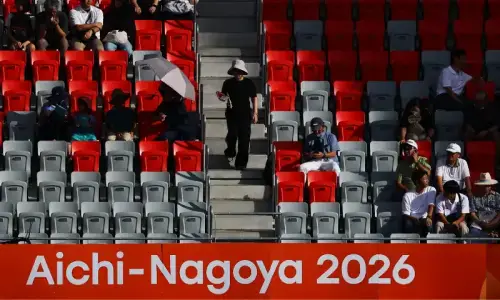
Satoshi Murate, secretary-general of the organising committee, said fewer than 60 per cent of tickets had been sold for eight sports, including football and the closing ceremony. Large sections of the athletics stadium were again left empty, while some tickets allocated to sponsors and other stakeholders went unused.
Murate also apologised for accommodation and transport mistakes that had left some athletes stranded for hours. He attributed some of the pressure to a late influx of around 2,000 additional athletes and officials, while saying services had improved from the early days of the Games.
The sporting programme itself continued to produce records.
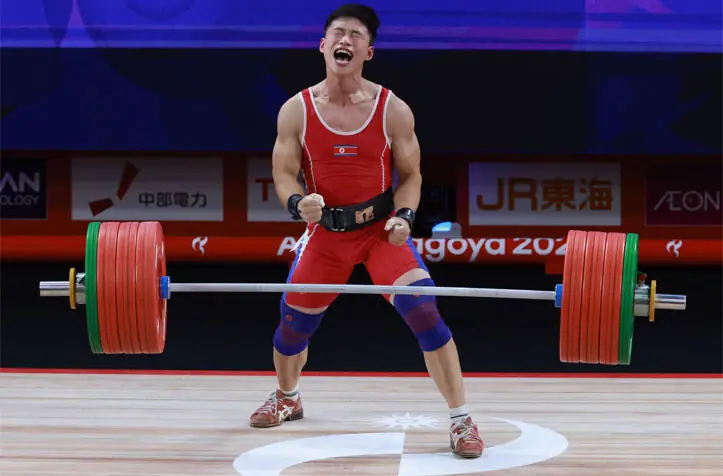
Six world records were set in weightlifting on Saturday, taking the Games total to 15 in four days. North Korea’s Ri Won Ju won the men’s 70kg gold after lifting a world-record 198kg in the clean and jerk for a 349kg total, while Japan’s Masanori Miyamoto took silver after setting a new snatch record of 154kg.
Indonesia’s Rahmat Erwin Abdullah successfully defended his Asian Games title in the 75kg category, setting world records in the clean and jerk and total. His 206kg clean and jerk and 366kg total added to a remarkable day for weightlifting.
The event also produced an emotional bronze for the Philippines’ Albert Delos Santos. The 20-year-old, whose parents were national weightlifters and whose sister competed at the 2018 Asian Games, dedicated the medal to his late father and coach, Alvin, who died of liver cancer in March.
On the athletics track, Bahrain’s Salwa Naser won the women’s 400m in an Asian Games record 49.20 seconds, finishing more than three seconds ahead of Iran’s Zahra Zarei Manoujan. Bahrain’s Nelly Korir also broke the Games record in the women’s 1,500m.
China’s 17-year-old Chen Yujie added another notable sprinting performance, winning the women’s 100m in a Games-record 11.06 seconds. The teenager, who turns 18 in December, said she now wants to make her mark at world championships and the Olympics.
In team sport, South Korea retained the women’s basketball title after surviving a late Japanese fightback to win 75-70. Kang Lee-seul scored 21 points, including three important late free throws, while Lee Hae-ran led South Korea with 24. Japan, seeking its first Asian Games women’s basketball title since 1998, had reduced the deficit to two points before the Koreans held on.
India also completed a sweep of the kabaddi titles, winning both the men’s and women’s finals against Iran.
For Japan, the day therefore offered contrasting images — home triumphs on the marathon course and in esports, but empty seats and operational problems away from competition. For China, it was another day of medal accumulation as the Games’ leading sporting powerhouse continued to build its haul.
In the men’s T20 cricket competition, Nepal and Afghanistan confirmed their place in the quarter-finals after the final Group ‘A’ fixture between Nepal and Japan was washed out.
The result meant it was the end of the road for hosts Japan in the competition.
The Group ‘B’ clash between Malaysia and Oman was washed out without a ball being bowled which meant Malaysia and Hong Kong advanced from Group ‘B’ with Oman bowing out.
Nepal, who had stunned Afghanistan in their earlier game, once again showed promise with the bat with Sundeep Jora and Lokesh Bam notching up half-centuries to take Nepal to 149-4 at the end of the 15th overs before the heavens opened.
In the quarter-finals, Pakistan face Hong Kong on Monday, India meet Afghanistan the same day, Sri Lanka lock horns with Nepal on Tuesday and Bangladesh take on Malaysia the same day.
Published in Dawn, September 27th, 2026