Makkah accord moves towards mly cooperation

• Army chiefs of Pakistan, Turkiye, Saudi Arabia meet in Riyadh to discuss collective defence
• Trilateral meeting agrees to boost intelligence, coordination, integrate capabilities
• CDF Munir, Saudi defence minister stress joint efforts to confront attacks on kingdom
ISLAMABAD: Pakistan, Turkiye and Saudi Arabia have resolved to take urgent steps to materialise military cooperation under the Makkah Joint Defence Agreement, with Islamabad and Riyadh separately vowing to continue joint efforts to confront attacks on the kingdom.
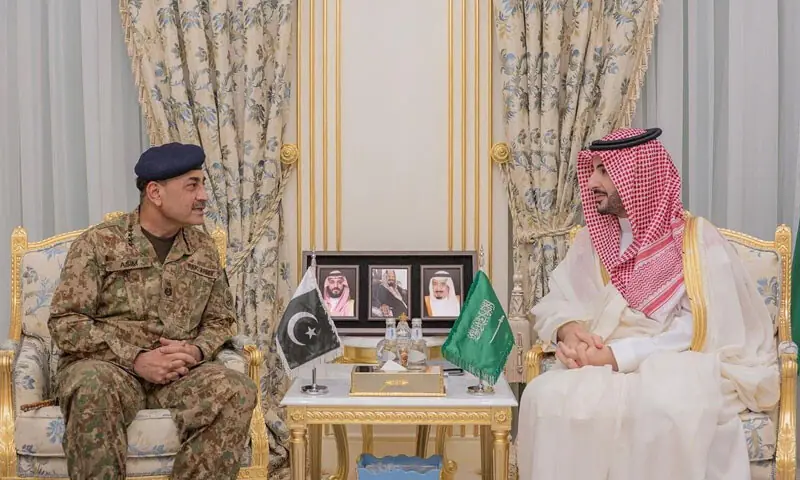
The decision was taken at a meeting of the military chiefs of the three countries in Riyadh late on Friday night, followed by a separate meeting between Chief of Defence Forces Field Marshal Asim Munir and Saudi Defence Minister Prince Khalid bin Salman.
The trilateral meeting reviewed the security situation and threats facing Saudi Arabia and condemned attacks reportedly directed towards the vicinity of Makkah city and the kingdom’s civilian and economic infrastructure.
The participants also agreed to strengthen cooperation between their armed forces through intelligence sharing, military coordination and integration of capabilities, with the aim of enhancing deterrence and collective defence.
More significantly, the Saudi defence ministry said the three countries had expressed their “shared determination to immediately begin translating the commitments contained in the Makkah Agreement for Joint Defence into effective military cooperation”.
The phrasing of the statement of the maiden meeting of the military chiefs of the participating countries of the alliance, convened amidst active hostilities, indicated that the agreement, signed in Makkah on Aug 7, was moving beyond political assurances towards the military arrangements needed to give practical effect to its collective defence commitment.
This came only about two weeks after Islamabad had maintained that the agreement was still being institutionalised and that there had been no discussion of Pakistani participation in strikes against Ansar Allah, commonly called Houthi, targets in Yemen. The Foreign Office had described the pact as a defensive alliance intended to strengthen regional security through deterrence. The latest statements from Riyadh suggested that the process was now being accelerated.
The Saudi defence ministry said the chiefs discussed “intelligence cooperation, military coordination, and capability integration”. The trilateral statement strongly condemned the attacks and commended the Saudi armed forces for their “vigilance and professionalism” in protecting the kingdom.
The statement, however, did not directly refer to Yemen or the Houthis, instead focusing on intelligence, coordination and capability integration.
The immediate military arrangements could involve closer intelligence sharing and early warning mechanisms, technical personnel, air defence specialists, sensors and electronic warfare capabilities that could be incorporated into Saudi Arabia’s existing defensive architecture.
The reference to “capability integration” also points to a requirement for closer liaison, planning and command and control arrangements. The three countries can cooperate while maintaining separate military systems, but integrating their capabilities would require mechanisms to coordinate how those systems operate together.
Pakistan and Turkiye also have different military capabilities and equipment inventories from Saudi Arabia, meaning the next challenge will be to determine what each can contribute and how those capabilities can be incorporated into the kingdom’s existing defence system. Turkiye has already indicated its readiness to meet Saudi military requirements, particularly on technical matters, while Pakistan has longstanding military ties with Saudi Arabia and personnel already serving in the kingdom.
CDF meets Saudi minister
The separate meeting between Field Marshal Munir and Prince Khalid served as a bilateral engagement following the trilateral session.
According to the Saudi defence ministry, the two sides stressed the need to continue “joint efforts to confront these attacks” in accordance with the Makkah pact. The composition of the Saudi delegation also indicated the wider security context of the discussions.
Alongside the defence minister and Chief of General Staff Gen Fayyadh bin Hamed
Al-Ruwaili were the national security adviser and the defence minister’s adviser for intelligence affairs. Field Marshal Munir was accompanied by the director general of military operations and his secretary.
The trilateral statement said the participants “strongly reaffirmed their commitment to collective defence” and their determination to defend “the security of the Kingdom of Saudi Arabia, its sovereignty, and the integrity of its territories”.
That formulation allows Pakistan and Turkiye to strengthen Saudi defences without immediately committing themselves to a wider war in Yemen. The foreign ministers had earlier affirmed Saudi Arabia’s right to take measures it considered appropriate to defend its security under Article 51 of the UN Charter.
Published in Dawn, September 27th, 2026