FCC sets aside IHC verdict in harassment case
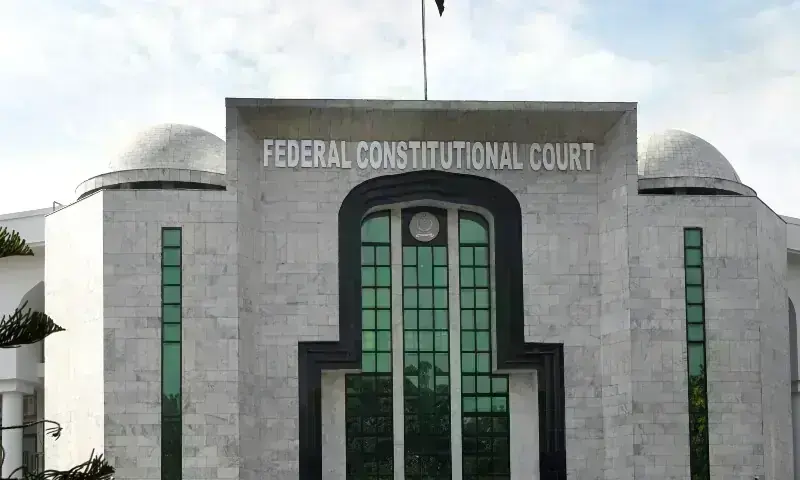

ISLAMABAD: The Federal Constitutional Court (FCC) on Monday set aside the Islamabad High Court’s (IHC) judgement in a workplace harassment case involving a female employee of the National Bank of Pakistan (NBP).
The high court, through its Dec 31, 2024 judgement, had restored in toto the Sept 3, 2013 decision of the Federal Ombudsman under the Protection against Harassment of Women at the Workplace Act, 2010 (Act), awarding the petitioners the major penalty of compulsory retirement under Section 4(4)(ii)(b) of the Act.
Headed by Chief Justice Aminuddin Khan and also comprising Justice Ali Baqar Najafi and Justice Syed Arshad Hussain Shah, a three-judge FCC bench took up a joint appeal filed by Usman Shahid and Aqeel Abbas against the IHC judgement.
Authored by Justice Najafi, the 18-page judgement observed that the scope of the high court’s interference under its constitutional jurisdiction was limited to cases where orders were passed without reappraisal of evidence, findings were based on non-reading or misreading of evidence, there was an erroneous assumption of facts or misapplication of law, or there was an exercise of excess or abuse of jurisdiction or arbitrary exercise of powers.
Scope of high court jurisdiction, nature of harassment discussed in 18-page judgement
On the question of jurisdiction under certiorari, the court observed that it exercised supervisory control to ensure that a tribunal had observed the law, but the high court could not substitute its findings on facts. It could interfere only if a tribunal exercised unlawful authority, such as deciding without evidence or failing to follow judicial norms, including the principles of natural justice, the FCC emphasised.
The dispute stemmed from Nadia Sarwar, who had been employed by the NBP since 2008, filing a complaint with the NBP president on Sept 24, 2012, against the petitioners, alleging sexual harassment at the workplace.
She then approached NBP’s divisional head by phone and email on March 26, 2013, but to no avail. She then filed another complaint about 13 weeks later with the NBP president, specifically mentioning instances of harassment, but again received no relief.
Two months later, she filed a complaint before the Federal Ombudsman under the Protection against Harassment of Women at the Workplace Act, 2010. The complaint was allowed and the petitioners were awarded the major penalty of compulsory retirement under Section 4(4)(ii)(b) of the Act.
The petitioners then filed representations before the President of Pakistan on Feb 14, 2014. The representations were allowed to the extent of setting aside the compulsory retirement order; however, the bank was directed to award censure under Section 4(4)(i)(a) of the Act. When she challenged the order before the IHC, the President’s order was set aside and the Ombudsman’s order restored in toto.
Examining the scope and definition of harassment under Section 2(h) of the Act, the FCC held that the definition was exhaustive, not extensive. The FCC said an act, conduct or attitude must be sexual in nature to constitute actionable harassment under the Act and that the Ombudsperson had no jurisdiction to inquire into disciplinary proceedings beyond this scope.
The FCC disagreed with previous judgements that had broadened the definition of harassment to include non-sexual conduct, stating: “Every sexual harassment was harassment but every harassment was not a sexual harassment.”
The FCC emphasised that the Act was intended to provide a smooth working environment for women by protecting their honour, modesty and respect by virtue of their gender, and could not be applied in a general context.
Published in Dawn, September 29th, 2026