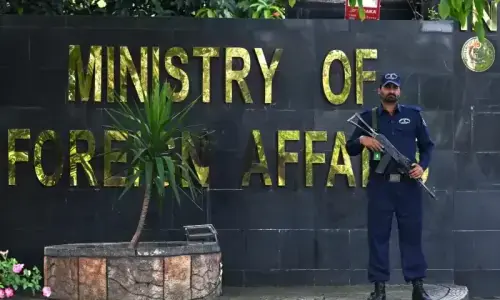
I was planning to devote this column to Memogate and Ambassador Husain Haqqani’s resignation, then I woke up one morning to learn that the topic had been rendered quaint by a Nato cross-border attack killing two dozen Pakistani soldiers and bringing the already fragile (not to say ostensible or notional) alliance between Pakistan and the United States very close to the breaking point. Then I realised that the two topics are aspects of a larger one, indeed of the twin elephants in both societies’ living rooms: the damage done when a military establishment becomes too powerful and unaccountable.
The only time I’ve ever met Husain Haqqani was at a seminar at Harvard University in 2006, organised by the journalist and activist Beena Sarwar. He wasn’t yet Ambassador to the US; Musharraf was still president. Most of the discussion was, I felt, preaching to the converted among elite-class Pakistani liberals about how the military was the problem and the solution was democracy in the form of elections and civilian rule. I’m not Pakistani, but I was an invited panelist at the seminar, so I took the liberty of challenging that consensus. Recall, I said, the sorry tit-for-tat excuse for democracy that Benazir Bhutto and Nawaz Sharif and their undemocratic parties inflicted on the country throughout the 1990s. That rivalry’s personal vindictiveness and pettiness, I asserted, did a lot of damage to the credibility of civilian leadership. Was it really clear that civilian rule was preferable to military rule under Musharraf?
For my pains I was, as I remember it, ganged up on by Husain Haqqani, the stern and formidable historian Ayesha Jalal, and Ayesha Siddiqa, whose book Military Inc. was about to be published. Haqqani in particular accused me of being “merely anecdotal,” meaning that the foibles of civilian politicians were incidental, whereas the military was a problem institutionally and structurally.
I still believe that my point was well taken, because there’s much that elected leaders can and should do to claim political space and assert their own authority, even – especially – if they’re being besieged or undermined by the military. If you’re elected to lead, you must accept the responsibility to do just that, and you must demonstrate courage and personal character in disdaining consequences to yourself when necessary. And I’m a reporter; merely anecdotal is what I do. But Haqqani was all too right – wasn’t he?
I’m aware that conspiracy theories have been flying about the notorious memo’s provenance. Like most conspiracy theories, they’re beside the point. It doesn’t matter whether Haqqani wrote the memo himself or was framed by the ISI; the result is the same. And the question to ask is Lenin’s: Who benefits?
A.J.P. Taylor (among many others) was right to point out that the armed forces are a fundamental institution of any state. But if the state is going to serve the interests of anyone else, the armed forces must be subject – and obedient – to civilian authority. This is what the authors of the US constitution understood in the 18th century, when they made the president the commander-in-chief of the armed forces. And it’s what President Truman understood when he fired the insubordinate General Douglas MacArthur in 1951, even though MacArthur was more popular with the American public at the time than Truman himself.
But Americans should be anything but self-congratulatory about such things. President Eisenhower, himself a retired general, was not only prescient but brave and patriotic when he took the occasion of his leaving office in 1961 to warn, in a rightly famous nationally televised speech, that a “military-industrial complex” (he coined the phrase) was poised to dominate America’s public life and economy. Half a century later America is hip-deep in the muck of Afghanistan, and – in addition to the death and destruction in Afghanistan itself and in Pakistan – the only Americans who are benefiting are the military itself and the shareholders of the companies that supply the war effort with everything from “contractors” (mercenaries) to drones to cheeseburgers for the troops. Military Inc., indeed.
Which brings us to the cross-border attack. Maybe Nato mistakenly or aggressively attacked over the border; maybe Pakistani troops fired first. Who knows? The New York Times has published a de rigueur, pro forma editorial urging an inquiry. Whatever the truth, it doesn’t matter, because the only people who gain from such an incident are the people who gain from war, and that’s not you or me. It’s also not the soldiers on all sides who are being killed. If I were Pakistani I would be furious, as I know many Pakistanis are, at the contempt for sovereignty that the attack shows. At the same time, we know that the Pakistani establishment is duplicitous. So where does that leave you and me? Does it help anyone if I claim your establishment is more duplicitous than mine, and vice versa?
Our two countries have arrived at a depressing and discouraging pass, both in relation to each other and internally. The exigencies of “defense,” which is a euphemism for war, have brought us here. As individuals, we feel (because we are) largely powerless to affect the course of events. As human communities there’s more we can do, as the Occupy Wall Street movement has been showing in America, and as the lawyers’ movement showed in Pakistan.
We’re in this together – and by “we” I mean Americans and Pakistanis. We’re not on opposing sides; we’re on the same side, against the warmongers of both states. And we are free to choose both our actions and our attitudes. As an American, Ken Williams, commented just this week on my Facebook page: “We can live with generosity and trust OR greed and fear. Each choice has outcomes.”

The views expressed by this blogger and in the following reader comments do not necessarily reflect the views and policies of the Dawn Media Group.