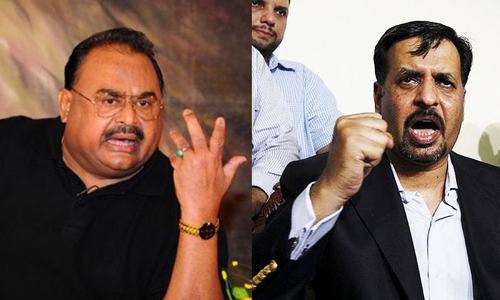
FROM being a political force claiming to represent urban Sindh’s Urdu speakers, the MQM has tried to transform itself into a national player.
However, while it has made its mark in Pakistan’s politics and has sent many members of the urban middle class to the legislatures, it has been unable to shed its reputation for using strong-arm tactics, especially where control of Karachi is concerned.
Many of the demons in the Muttahida’s closet were dragged out into public view by party dissident and former Karachi mayor Mustafa Kamal when he returned to the city earlier this month.
Mr Kamal launched a number of devastating salvos primarily targeted at MQM supremo Altaf Hussain, accusing him of working with RAW and misleading the party cadre.
The Muttahida leadership has blamed elements within the establishment for engineering the split. This may be possible as the establishment was also believed to have been instrumental in carving out the Afaq Ahmed-led Haqiqi faction from the MQM in the early ’90s. However, then, as well as now, many of the dissidents could hardly be considered ‘clean’, as Afaq Ahmed and many of his cohorts were believed to have been involved in violence while still attached to the mother party.
In Mustafa Kamal’s case, a number of individuals linked to his unnamed party have had less than immaculate records, associated as they were with the Karachi Tanzeemi Committee, considered the Muttahida’s enforcement arm. This brings us to the key issue: that of the MQM’s association with and acceptance of violence.
The Muttahida for long has played the victim card, claiming its cadres have faced the oppressive might of the state, during the infamous operations of the ’90s, and more recently, for example when the paramilitary Rangers went marching into Nine-Zero, the MQM’s headquarters, last year. Some of these complaints may be valid.
Yet what the MQM leadership is not talking about is the fact that until the state took action, the party controlled Karachi with an iron grip, through its shadowy militant wing. The city’s residents have not forgotten when Karachi used to shut down almost completely on the MQM’s calls for days of ‘mourning’ or protest.
It would not be incorrect to say that the party led the way in introducing gun culture to urban Sindh’s politics, as well as the politics of ethnic division. And accusations that the party thrived on extortion are equally hard to dismiss, while the MQM tolerated little dissent — internal or external.
The political wing of the MQM needs to acknowledge these sordid facts and admit that condoning violence was ill-advised. This should be followed by a permanent break with those who wield the gun within its ranks.
Local polls in Sindh have shown that even without the coercive force of party militants, the MQM can perform well at the ballot box.
Published in Dawn, March 18th, 2016