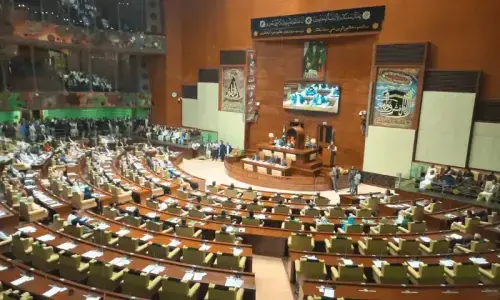
KARACHI: In the light of warnings about this summer being even more severe than last year when hundreds of people succumbed to the heat, representatives of civil society called a press conference at the Karachi Press Club on Sunday to air their concerns regarding increasing loadshedding and frequent power breakdowns in the city.
“This is not really loadshedding because loadshedding is carried out to balance the shortfall of electricity. What K-Electric is doing by carrying out unscheduled loadshedding for extended durations and cutting off power supply to areas is punishing entire communities for the fault of a handful of people,” said Karamat Ali, director of the Pakistan Institute of Labour Education and Research (Piler).
“Collective punishment is against the Constitution of Pakistan. A company should run on a set framework according to the law of the land. In KE’s case, the National Electric Power Regulatory Authority [Nepra] is the ruling authority over it. But not caring for Nepra’s rules and doing as it pleases, is this KE or is this a rehash of the East India Company, which thought that the law of India did not apply to it? For the fault of one or two, the East India Company used to punish entire villages. Recently we heard that KE shut off power of Baba and Bhit islands for seven days just because of a few defaulters there. What, are they working in a jungle? This is not acceptable in this day and age. This is a democracy where every individual matters,” said Karamat Ali.
He added that KE itself was not increasing generation according to its capacity in order to save costs and their high-loss areas where they inflicted the longest hours of loadshedding is where the middle class and poor segments of society live. “We want the chief minister, the commissioner of Karachi as well as Nepra to look into this. If KE doesn’t pull up its socks and shape up now, we will mobilise the people of Karachi and ask the government to take the company back as it is an essential service after all,” he said.
Nazim Haji, entrepreneur and former chief of the Citizens-Police Liaison Committee, shared Nepra’s findings when it issued a show-cause notice to KE last year in violation of the obligations, laws and terms and conditions of the licence issued to them by the regulatory authority. “Nepra noted that KE was constantly violating the terms and conditions of rules and regulations that contributed to the situation in 2015 when so many people died due to extreme heat in the face of extended loadshedding. It also said that it was not satisfied with KE’s explanations about its generation capacity and reduced output supply. It was the first time that Nepra asserted itself instead of being a silent spectator,” he said.
“Even when KE does increase generation, they also decommission plants. What we the public want is to know what is really going on. KE has data but they don’t share it on their website like a good corporate company should be doing,” Mr Haji said.
“Yes, I will say that the industry has been exempted by them from this loadshedding but what about the common public? I urge them to make everything transparent and the public, too, will cooperate with them as far as paying bills and dealing with the kunda system is concerned.”
Mahnaz Rehman, of the Aurat Foundation, said that depriving citizens of power was like depriving them of their basic rights. “Women stay home more than men and they suffer when left without electricity in their small claustrophobic homes,” she said.
Nasir A. Mansoor, deputy general secretary of the National Trade Union Federation (Pakistan), pointed out that even when the industry had power, the worker who works there should also have electricity when he reaches home tired after a hard day’s work for him to come back rested and fresh to his job the next day.
Senior trade unionist Habibuddin Junaidi said that KE was a good example of the failure of privatisation, something which the government should think about reversing.
Latif Mughal, a former KESC employee, said that earlier when KESC was a government-owned entity there was a proper budget set aside for the corporation to prepare for the summer during the winter. “But they don’t do this anymore and then they have a crisis on their hands during the summer,” he said, adding that it was a poor decision by the company to replace copper wires with silver as silver wires, quite obviously, cannot take the load.
Published in Dawn, May 23rd, 2016