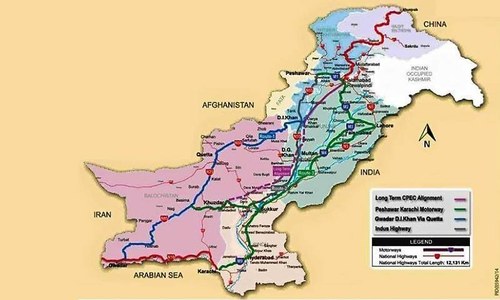
ISLAMABAD: Chairman of the National Highway Authority (NHA) Shahid Ashraf Tarar has given a new twist to the controversy over the eastern and western routes of the $46 billion China-Pakistan Economic Corridor (CPEC) by claiming that the eastern route is not part of the project.
“The actual corridor comprises the western route whereas the eastern route is aimed at improving the existing north-to-south motorway connectivity,” he said while talking to Dawn.
The claim made by the NHA chief is significant amid strong criticism by opposition parties that the government had given priority to the eastern route of the CPEC and ignored the western route.
Some standing committees of the Senate and National Assembly have also raised concern over the government’s attitude towards the western route that starts from Burhan on Peshawar-Islamabad motorway and, after moving through Dera Ismail Khan, Zhob, Quetta, Surab and Hoshab, ends at Gwadar.
“It is a misconception that the route named as eastern route is part of the CPEC. Rather it is the NHA’s own project aimed at improving motorway connectivity to share traffic burden of the corridor,” Mr Tarar said.
He said some of the missing portions of motorway connectivity would be constructed by the NHA, simultaneously with the western route, in three years.
A recent report of the Senate’s Special Standing Committee on the CPEC said the government was giving priority to the eastern route of the corridor while ignoring the western one.
But the NHA chief said most of the western route-related projects would be completed in two years and those on the so- called eastern route in three years.
“We have split construction of a 285km road between Halka, an area near Islamabad, and Dera Ismail Khan into five parts to ensure that the work is completed in two years.”
He said Halka-Dera Ismail Khan road was the biggest missing link in the proposed western route, which would be completed by Aug 2018.
He said contracts for three of the five parts of the highway had been awarded to the National Logistic Cell, the Frontier Works Organisation and a joint venture of a Chinese firm, Limak, and a local company, ZKB.
The Senate committee’s report said the China-Pakistan Joint Cooperation Committee on the CPEC had excluded the western route from the project. But a document containing minutes of 5th meeting of the committee held on Nov 2015 says: “The two sides have reached consensus on the principle of one corridor with multiple passages for CPEC transport planning, aiming at directly benefiting social-economic development of Pakistan, particularly the western route and north-western regions.”
Project cost
The NHA chief cleared an ambiguity about the cost of the CPEC and Chinese investment in it and said the cost of the project would be borne by the government of Pakistan, local investment on a build-operate-transfer basis, the Chinese government and international donors.
Of the $46bn, he said, $35bn would be invested by international power companies and $11bn would be spent on road projects, including $4 to $5bn local investment. The remaining amount will be invested by the Chinese government and international donors.
The local investment will also cover projects like development of Gwadar city, port and airport, a railway line project called ML-I, a road project in Gwadar called East Way Express, etc.
He said the investment of $11bn had been proposed for short-term or early harvest projects which would be completed in three to five years. The remaining amount will be utilised for medium- and long-term projects which will be completed within five to 10 years and 10 to 15 years.
One of the long-term projects is the widening of 533km two-lane Dera Ismail Khan-Quetta road. Under the project, the road will be turned into a four-lane carriageway. Its feasibility study is being carried out by the National Engineering Services of Pakistan.
Land acquisition
The NHA chairman said land was being acquired for the western route-related projects in phases. A study has been carried by his department under which land for the six-lane road and 100m right-of-way will be acquired to meet future requirements.
About the proposed power generation projects and economic zones along the western route of the CPEC, he said once the road was completed, the facilities would be provided at the proposed sites.
It has been learnt that the Board of Investment has prepared a plan for establishment of 38 economic zones along the corridor.
Published in Dawn, July 5th, 2016