

Putin, Xi agree to jointly combat Afghanistan ‘threats’
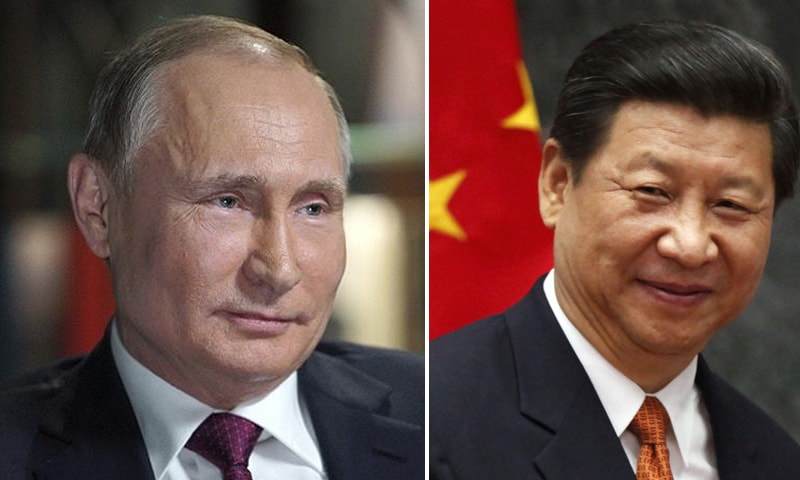

MOSCOW: Russian President Vladimir Putin and his Chinese counterpart Xi Jinping agreed on Wednesday their countries would step up efforts to counter “threats” emerging from Afghanistan following the Taliban’s takeover, while German Chancellor Angela Merkel said the international community must maintain dialogue with the group if it wanted to protect “improvements made” in the country during two decades of Nato deployment there.
According to the Kremlin, during a telephone call the Russian and Chinese leaders “expressed their readiness to step up efforts to combat threats of terrorism and drug trafficking coming from the territory of Afghanistan”.
They also spoke of the “importance of establishing peace” in Afghanistan and “preventing the spread of instability to adjacent regions”.
Putin and Xi “agreed to intensify bilateral contacts” and “make the most of the potential” of the Shanghai Cooperation Organisation (SCO) that is due to convene a summit in Tajikistan next month.
German chancellor says the international community must remain engaged with Taliban
Several ex-Soviet republics in Central Asia — where Moscow holds military bases — share a border both with Afghanistan and China.
While Moscow has been cautiously optimistic about the new leadership in Kabul, Putin has warned of Afghan militants entering neighbouring countries as refugees.
Putin has also criticised the involvement of outside powers in Afghanistan’s domestic affairs and said Moscow had “learnt lessons” from the Soviet Union’s decade-long invasion of the country.
For its part, after the Taliban swept to power on Aug 15, China said it is ready to deepen “friendly and cooperative relations” with Afghanistan.
According to the Chinese media, the two leaders did not echo the G7’s call for the Taliban to allow people to flee the country after Aug 31, as desperate crowds left behind by the withdrawal of US troops continue to fear for their safety.
China and Russia are not part of the G7, a grouping of rich democracies that includes the United States and Britain. President Joe Biden said on Tuesday the United States expected to finish evacuations by Aug 31. And the Taliban said all foreign evacuations from the country must be completed by then.
However, the G7 leaders agreed on Tuesday to press the Taliban to allow safe passage to Afghans wanting to leave after Aug 31.
In the call with Putin, Xi reiterated China’s position of non-interference and of respecting Afghanistan’s sovereignty and independence, China’s People’s Daily reported.
The report said Putin told Xi he shared China’s positions and interests in Afghanistan and he was willing to work with China to “prevent foreign forces from interfering and destroying” Afghanistan.
Xi urged all parties in Afghanistan to build an open and inclusive political framework, implement moderate, stable policies and cut ties with all terrorist groups.
Putin said Russia wanted to work with China to fight terrorism and drug smuggling and to prevent the security risks from “spilling out” of Afghanistan.
Dialogue with Taliban
In a speech to parliament, the German chancellor said: “Our goal must be to preserve as much as possible what we have achieved in terms of changes in Afghanistan in the last 20 years. This is something the international community must talk about with the Taliban.”
Progress made over the years includes access to basic necessities — 70 per cent of Afghans now have access to drinking water as opposed to 20pc a decade ago. And nine in 10 people have electricity supplies, up from just two in 10 in 2011.
The fact that the Taliban are back in power is “bitter but we have to deal with it,” Angela Merkel said. “Many things in history take a long time. That is why we must not and will not forget Afghanistan,” she said.
“Because even if it doesn’t look like it in this bitter hour, I remain convinced that no force or ideology can resist the drive for justice and peace,” said Merkel, who grew up in communist East Germany but saw the regime collapse in 1989.
Published in Dawn, August 26th, 2021




























