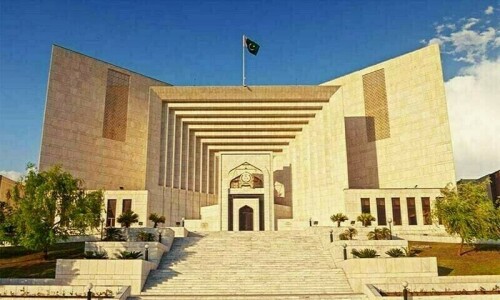
THE rumbling within the Supreme Court grows louder. In an order pertaining to held-up pension payments by the National Bank of Pakistan, Justice Mansoor Ali Shah has underlined that implementing the apex court’s verdicts is not ‘optional’.
“To disregard or delay the implementation of [the Supreme Court’s] verdicts is to challenge the very framework of our legal system,” he has remarked in the order, noting that when the apex court issues a verdict, it does so as the ultimate interpreter of the Constitution. He has warned that non-compliance sets a dangerous precedent that could lead to executive overreach.
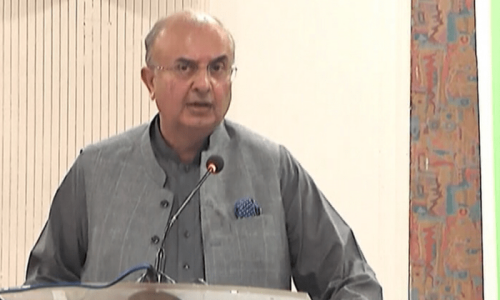
Justice Shah’s observations, also reflected in his remarks a day later at a conference, have stirred speculation over how proceedings in the reserved seats case may unfold. It may be recalled that the government recently enacted legislation designed to frustrate the Supreme Court’s order in the case, while its representatives and allies have taken turns to attack both the judgement and the eight judges behind it.
“The power to hold individuals or entities in contempt for failing to comply with a court order is fundamental to the judiciary’s ability to function effectively,” Justice Shah observes in his order. “Without this power, the judiciary would be rendered toothless, unable to enforce its decisions, thereby jeopardising the administration of justice.”
If the sword of contempt is unsheathed, the ECP could be its first casualty. Having acted on multiple occasions as if it is under no compulsion to obey the laws or court orders, the ECP has, in this instance too, refused to respect the Supreme Court as the final arbiter of the Constitution. It should have allotted whatever reserved seats accrued to the PTI by now in line with court directives, but has chosen, instead, to play tag-team with the government in subverting the verdict.
Still, it must be acknowledged that part of the blame falls on the court itself. Due to certain past actions and decisions, the apex court earned the distrust of the political class, lending itself to controversy. Such actions include the endorsement of military takeovers, and its role in dislodging at least two prime ministers. It must be noted, however, that even in these cases, its verdicts were implemented.
Secondly, the court must also acknowledge that the absence of the detailed verdict in the reserved seats case continues to foster controversy. While it should take adequate measures to enforce its writ and uphold the constitutional order, it must also realise that it needs to announce the detailed verdict soon for the objections against it to be addressed with finality.
The reserved seats case has turned into a charged political issue. Wisdom and restraint are needed in abundance to see the matter through.
Published in Dawn, August 12th, 2024