• Developing countries’ demand for $1.3 trillion reduced to paltry sum of $250 billion; fresh text expected today
• Pakistan pitches regional diplomacy for glaciers’ sake
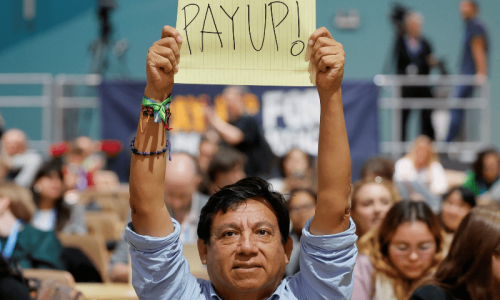
A NEW draft of the climate finance goals failed to elicit an agreement between the developing and developed world, as Pakistan joined other countries to trash the suggestion to offer an annual $250 billion by 2035.
“The demand of $1.3 trillion has been reduced to $250 billion only, which is unacceptable,” Arif Goheer told Dawn in response to a question about the new collective quantified goal. He, however, said the adaptation of the ‘Baku Adaptation Roadmap (BAR)’ was welcomed by Islamabad.
Before the release of the draft agreement in which the developed world finally agreed to put forth the quantum of finance, a press conference by the South Asia civil society criticised the attitude of the Global North, saying no deal was better than a bad deal.
Before the new text was issued, Dr Abid Sulehri of the Sustainable Policy Development Institute termed the current deadlock a “collective suicide”, saying the anticipated withdrawal of the US might push the Global North to think of some sort of a compromise. He added that in case the developed world failed to deliver and the US also walked away that would probably be a collapse of the Paris Agreement.
Pakistan’s diplomacy to save glaciers
As the Hindu Kush and Himalaya region reels from flash floods and rapid melting of glaciers, Pakistan has pitched a joint front to address challenges in the cryosphere, advocating a ‘climate diplomacy initiative’ to save the third pole.
Due to climate-induced heat waves, glaciers are disproportionately affected, particularly in the HKH region which includes Pakistan, Bangladesh, Nepal, India and Bhutan among other countries. The HKH region is warming at an alarming rate, losing glaciers at twice the speed compared to other mountain ranges due to its proximity to the tropics.
“Glaciers in some regions, such as the tropical Andes, or the Indus and Tarim basins in High Mountain Asia, contribute a high proportion of seasonal water supplies…” the 2024 report on the ‘State of Cryosphere’ said, adding that in the current emission scenario, the Hindu Kush and Himalayas are going to lose 80 per cent of their snow. This will lead to food and water insecurity as well as loss of livelihoods in the region.
Against this backdrop, Romina Khurshid Alam, the prime minister’s climate change coordinator, pushed for a ‘mountain agenda’ at the COP29 focusing on the “unique vulnerabilities” these mountain ranges faced due to climate change. The minister, speaking at an event hosted by Kyrgyzstan last week, said over “13,000 glaciers” were a vital source of the region’s water supply for agriculture and catered to the needs of millions across South Asia.
Joint push: a regional approach
In another event, hosted by Bhutan in the first week of COP29, Ms Alam floated a similar proposal, giving the importance of these glaciers for the region. Pakistan was open to climate diplomacy because disasters did not differentiate between nation-states, she said, advocating a regional approach to resolve this issue.
Pakistan asks the world to do more as climate justice is linked to climate diplomacy, the PM’s aide told Dawn at the Pakistan Pavilion.
“Mountainous countries like Pakistan, Nepal, and even India, we are the most vulnerable mountainous communities. We are losing our culture, and livelihood [due to global warming],” said Maheshwar Dhakal, joint secretary at Nepal’s Ministry of Forest and Environment in his comment to Dawn.
He endorsed the idea of regional diplomacy, saying Nepal wanted all mountainous countries to come to an understanding.
Bangladesh’s Sanjay Kumar Bhowmik, a former additional secretary at the climate ministry, said that all HKH countries were working together under the umbrella of the Nepal-based International Centre for Integrated Mountain Development (ICIMOD) to save glaciers.
He said Bangladesh’s hilly region comprises one-fourth of the country. One of the adaptation projects in the country is being run by ICIMOD, he told Dawn at Bangladesh Pavilion in Baku. On the other hand, Bhutan also pushes for the mountain agenda at high-level ministerial meetings, demanding a goal fit for purpose.
Safdar Mirza, an environmental activist from Gilgit-Baltistan, said there was a disconnect between the community and measures taken by the government for adaptation, such as early warning systems. He said the GB Environmental Protection Agency recently wrote a letter about GLOFs seeking details about the installation of early warning systems.
On global forums, such as climate conferences, a joint push will be a good idea, according to Dr Miriam Jackson, an experienced glaciologist working for the International Cryosphere Climate Initiative.
“I think it is a very good idea for mountain countries to work together,” she said, adding that a separate negotiation bloc, however, could stretch resources.
This story was produced as part of the 2024 Climate Change Media Partnership, a journalism fellowship organised by Internews’ Earth Journalism Network and the Stanley Centre for Peace and Security.
Published in Dawn, November 23rd, 2024