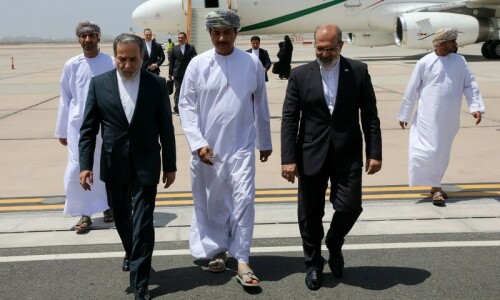
Iranian and US negotiators closed on Friday a fifth round of nuclear talks in Rome with “some but not conclusive progress”, mediator Oman said, after a public disagreement over Tehran’s uranium enrichment.
The talks, which began in April, are the highest-level contact between the foes since the United States quit a landmark 2015 nuclear accord during President Donald Trump’s first term.
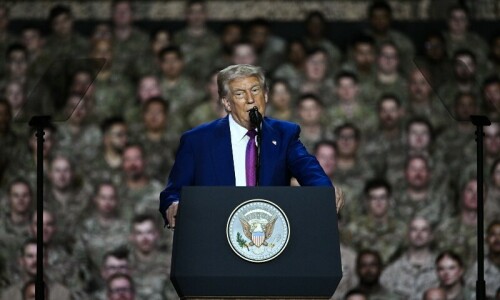
Since returning to office, Trump has revived his “maximum pressure” campaign on Iran, backing talks but warning of military action if diplomacy fails.
Iran wants a new deal that would ease the sanctions which have battered its economy.
“The fifth round of Iran-US talks have concluded today in Rome with some but not conclusive progress,” Omani Foreign Minister Badr Albusaidi said on X, adding that he hoped “the remaining issues” would be clarified in the coming days.
Iranian foreign ministry spokesman Esmaeil Baqaei had earlier said that chief US negotiator Steve Witkoff had left the talks “due to his flight schedule”. The fourth round of talks, in the Omani capital Muscat, ended with a public spat over enrichment.
Witkoff said Washington “could not authorise even one per cent” enrichment — a position Tehran called a red line, citing its rights under the nuclear Non-Proliferation Treaty.
‘Fundamental differences’
Ahead of Friday’s talks, Araghchi said “fundamental differences” remained with the United States, while adding that Tehran was open to its nuclear sites undergoing more inspections.
“We will not have an agreement at all” if the United States wants to prevent Iran from enriching uranium, he said.
The talks came ahead of a June meeting of the UN nuclear watchdog, the Vienna-based International Atomic Energy Agency (IAEA), and the October expiry of the 2015 accord.
The deal, known as the Joint Comprehensive Plan of Action, aimed to allay Western suspicions that Iran was seeking a nuclear weapons capability, an ambition that Tehran has consistently denied.
In return for curbs on its nuclear programme, Iran had received relief from international sanctions. But the accord was torpedoed in 2018 when Trump unilaterally withdrew the United States and reimposed sanctions.
A year later, Iran responded by ramping up its nuclear activities.
It is now enriching uranium to 60pc — far above the deal’s 3.67pc cap but below, though close to, the 90pc level needed for a nuclear warhead.
‘It’s quite simple’
Analysts in Tehran said Iran was unlikely to back down.
“It’s quite simple; if the US expects Iran to halt nuclear enrichment, then there can’t be a deal,” said Mohammad Marandi, a political scientist who was once an adviser on the nuclear issue.
The Atomic Energy Organisation of Iran says the country’s nuclear industry employs 17,000 people, similar to other countries where uranium is enriched for civilian use.
“The Netherlands, Belgium, South Korea, Brazil and Japan enrich [uranium] without possessing nuclear weapons,” its spokesman Behrouz Kamalvandi said.
Iran’s enmity with Israel, whose main backer is the United States, has been a constant backdrop to the talks.
In a letter to the United Nations, Araghchi wrote: “We believe that in the event of any attack on the nuclear facilities of the Islamic Republic of Iran by the Zionist regime, the US government will also be involved and bear legal responsibility.”
The warning came after CNN, citing unnamed US officials, reported Israel was making preparations to carry out such a strike.
The White House said Trump had a “productive discussion” with Israeli Prime Minister Benjamin Netanyahu on Thursday about Iran and the fatal shooting of two Israeli embassy staff in Washington.
‘Irreversible’
The 2015 deal provides for the possibility of UN sanctions being reimposed through a mechanism called “snapback” if Iran fails to fulfil its commitments.
The agreement’s three European parties — Britain, France and Germany — have warned they will trigger the mechanism if the continent’s security is threatened.
Araghchi said such a move would have “consequences — not only the end of Europe’s role in the agreement, but also an escalation of tensions that could become irreversible”.