Judges transfer case: FCC rejects intra-court appeal filed by IHC judges
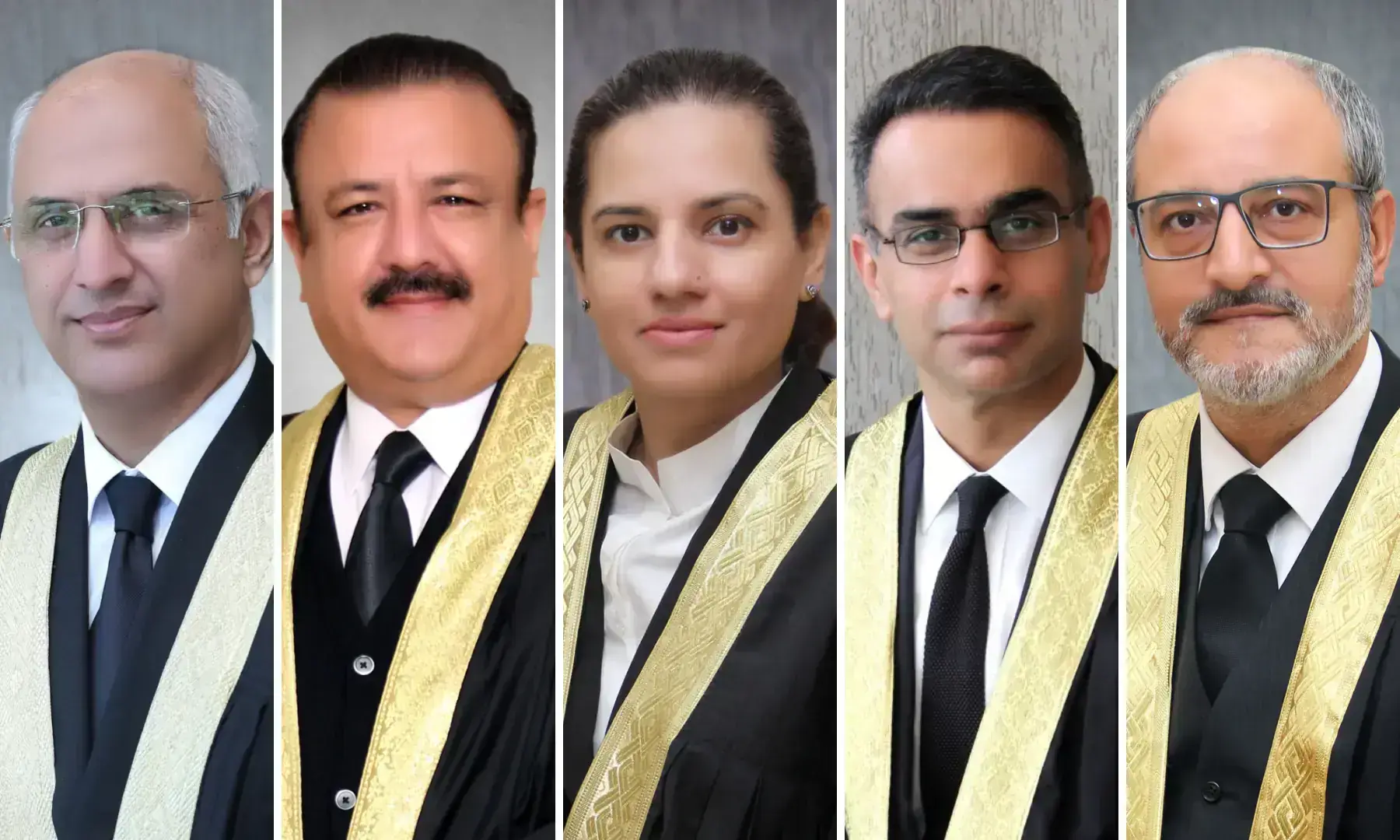

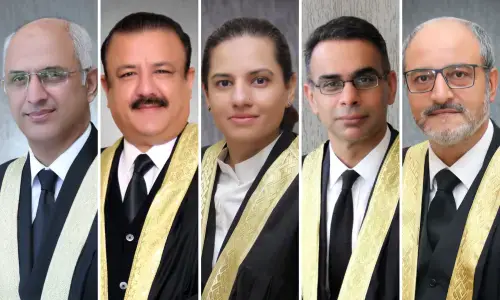
The Federal Constitutional Court (FCC) on Monday rejected on Monday a set of intra-court appeals, including one filed by five Islamabad High Court (IHC) judges in a judges transfer case, for non-prosecution.
The case pertains to the transfer of three judges from other high courts to the federal capital, and the IHC judges had challenged a decision by the now-defunct Constitutional Bench (CB) of the Supreme Court to uphold the transfers.
However, the appeal was fixed before the FCC following its establishment under the 27th Amendment.
A six-member FCC bench, headed by Chief Justice Aminuddin Khan and comprising Justices Syed Hasan Azhar Rizvi, Ali Baqar Najafi, Muhammad Karim Khan Agha, Rozi Khan Barrech and Arshad Hussain Shah, took up nine appeals pertaining to the case today.
As the proceedings began, the court associate called out the names of each of the lawyers representing different clients, and when they did not appear, the FCC dismissed six of those appeals one at a time, dictating separate orders for each plea.
The rejected appeals included the one filed by IHC Justices Mohsin Akhtar Kayani, Babar Sattar, Sardar Ejaz Ishaq Khan, Saman Rafat Imtiaz and Tariq Mehmood Jahangiri. These judges were also not present at the hearing.
Apart from the appeal moved by the five judges through senior counsel Muneer A. Malik, the FCC also took up pleas filed by Tahir Faraz Abbasi through Advocate Abid Shahid Zuberi, Raja Muqsit Nawaz Khan and PTI founder Imran Khan through counsel Idrees Ashraf, the Lahore High Court Bar Association (LHCBA) and Lahore Bar Association (LBA) through counsel Hamid Khan, and the Karachi Bar Association, Muhammad Shoaib Shaheen and Riasat Ali Azad through counsel Faisal Siddiqi.
From these nine appeals, the FCC adjourned the hearing on three pleas for an indefinite period.
Among them was also Imran’s plea, whose counsel Ashraf sought directives for meeting the incarcerated former prime minister. He argued that he needed instructions from Imran after the enactment of the 27th Amendment.
The counsel pleaded that he had to file additional grounds since he had moved the appeal against the SC’s short order. Therefore, he argued, a meeting with the client was necessary.
However, Justice Aminuddin rejected the request, observing that the counsel should approach the forum that sentenced his client. Justice Aminuddin said the matter did not fall in the FCC’s domain.
But, the counsel argued that a directive by the FCC would “fulfil the requirement of complete justice” under Article 187 of the Constitution.
During the hearing, Advocate Ajmal Toor appeared before the court on behalf of senior counsel Hamid Khan, who is representing the LHCBA and LBA.
Advocate Toor sought more time from the court as Hamid was unavailable.
The court then also adjourned the hearing on the pleas of the two lawyers’ bodies for an indefinite period.
Pleas on judges transfer
On June 19, the now-defunct CB issued a 3-2 majority judgement, declaring that the transfer of three judges to the IHC from three other courts was within the framework of the Constitution.
The judgement was issued on petitions challenging the transfers of Justice Sardar Mohammad Sarfraz Dogar from the LHC, Justice Khadim Hussain Soomro from the Sindh High Court and Justice Muhammad Asif from the Balochistan High Court to the IHC.
The controversy centred around the alteration of the judges’ seniority list after these transfers as Justice Dogar was made the senior puisne judge, which paved the way for his appointment as the acting IHC chief justice after Justice Aamer Farooq’s elevation to the SC. Justice Dogar is now the IHC chief justice.
The five IHC judges had challenged the June 19 decision and filed an intra-court appeal.
The judges contended in the appeal that the June 19 order impermissibly read in “permanent” in Article 200(1) and (2) of the Constitution when no such language was contained in the provision.
The appeal pleaded that the constitutional bench had misunderstood the provisions of Article 200 by reading sub-article (1) in isolation from other provisions of the article by not holding that transfers envisioned in Article 200(1) were only for a temporary and time-specified period.
The order also failed to interpret articles 200 and 175A, without scuttling and undermining the powers of the Judicial Commission of Pakistan under Article 175A of the Constitution, the appeal argued, adding that independence of the judiciary did not allow bestowing onto the executive a much more expansive power than what the text of Article 200 and the foundational principles of constitutional law can bear.
For his part, Imran’s petition on the issue argued that the June 19 judgment had eroded the safeguards aimed at preserving judicial independence since it circumvented the constitutionally enshrined appointment process.
On Saturday, the five IHC judges also filed a miscellaneous petition, challenging the fixing of their appeal before the FCC.
In the petition, the judges asked the FCC to return the intra-court appeal to the SC, arguing that the matter constitutionally fell within the jurisdiction of the Supreme Court.
The petition stated that the appeal was shifted to the FCC under the 27th Constitutional Amendment, but contended that the amendment itself contradicted the Constitution.
In their application, the petitioners also argued that the Constitution clearly outlined the legislature, executive, and judiciary as the three essential pillars of the state and delineated limits and powers for each.
It was also fixed for hearing today. However, as the judge’s main appeal was dismissed, there was no occasion to take up the miscellaneous application.