• Sajid and Naveed Akram had spent November in southern Philippines — a hotbed for extremist groups
• Family in Indian city of Hyderabad unaware of his ‘radicalisation’
• Albanese says Naveed came on intel radar in 2019, but wasn’t considered a threat then
SYDNEY/MANILA/HYDERABAD: The alleged gunman shot dead by police during Sunday’s attack on Australia’s Bondi Beach was originally from the Indian city of Hyderabad, and his family did not know about his “radical mindset”, Indian police said on Tuesday.
The father and son duo accused of carrying out the attack had travelled to the southern Philippines — a hotbed for extremist groups — before the attack that Australian police say appeared to be inspired by the militant Islamic State (IS) group.
Sajid Akram and his son Naveed had opened fire on people thronging the famous beach for the Jewish festival of Hanukkah on Sunday evening, killing 15 people and wounding dozens more.
Authorities said both men had travelled to the Philippines last month — the father on an Indian passport and the son on an Australian one — and spent all of November there.
IS-linked networks are known to operate in the Philippines — especially the southern Mindanao region — but have been reduced to weakened cells operating in the southern Mindanao island in recent years, far from the scale of influence they wielded during the 2017 Marawi siege.
Its porous borders and rugged terrain made it a conducive environment for foreign fighters seeking training with groups such as Abu Sayyaf and Islamic State-linked factions.
A 2023 US State Department report said the Philippines remained a destination for what it called “foreign terrorist fighters” from Indonesia, Malaysia, the Middle East, and Europe.
Australian Federal Police Commissioner Krissy Barrett said that early indications pointed to a terrorist attack inspired by IS, adding that these were the actions of those “who have aligned themselves with a terrorist organisation, not a religion”.
Police also said the vehicle which is registered to the younger male contained improvised explosive devices and two homemade flags associated with ISIS, or Islamic State, a militant group designated by Australia and many other countries as a terrorist organisation.
The father and son were driven by “Islamic State ideology” when they fired on crowds at Bondi Beach, Prime Minister Anthony Albanese said on Tuesday.
“With the rise of ISIS more than a decade ago now, the world has been grappling with extremism and this hateful ideology,” he said in a separate interview.
Albanese said Naveed, reportedly an unemployed bricklayer, had come to the attention of Australia’s intelligence agency in 2019 but was not considered an imminent threat at the time.
“They interviewed him, they interviewed his family members, they interviewed people around him,” Albanese said.
“He was not seen at that time to be a person of interest.”
Indian police statement
Sajid Akram, 50, had got a degree in commerce in Hyderabad, the large and bustling tech and pharma hub that is the state capital, the statement said.
He then moved to Australia in November 1998 to find work and married a woman described as of European origin, with whom he had a son and a daughter.
He went back to India six times for family-related reasons such as property matters and to visit his parents but did not return when his father died, the police statement said.
It said Akram’s family seemed unaware of his “radicalisation” and it appeared unconnected with India, where police had no “adverse record” of him before he left in 1998.
“The family members have expressed no knowledge of his radical mindset or activities, nor of the circumstances that led to his radicalisation,” the statement said.
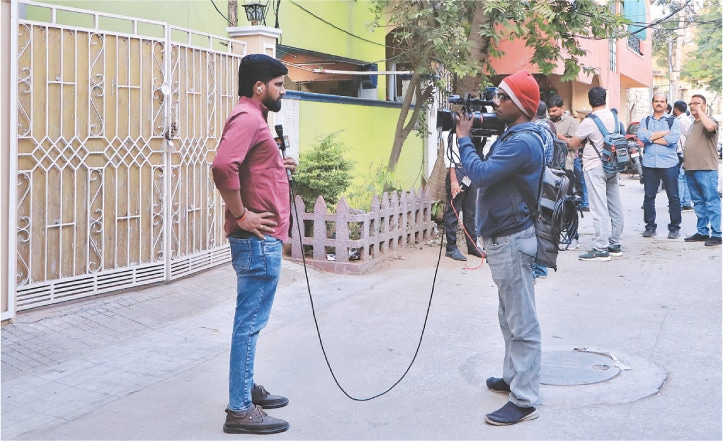
When Reuters on Tuesday visited ‘Zehra Cottage’, Akram’s family home in the Al Hasnath colony of Hyderabad’s Tolichowki area, a middle-class Muslim neighbourhood, the three-storey building’s gates were shut. No family members were to be seen.
Most neighbours were unwilling to speak to reporters. One neighbour said a doctor lived in the house, referring to Akram’s brother. His elderly mother also stays with them, he said. “We heard he (the brother) is a doctor,” said the neighbour, who spoke on condition of anonymity.
Published in Dawn, December 17th, 2025