• Defence minister accuses Kabul, Delhi of waging ‘proxy war’
• Calls regional situation ‘price of 1980s, post-9/11 decisions’
• Terms US ‘a critical partner’; says Pakistan will stand by ‘brothers in Iran’
DEFENCE Minister Khawaja Asif has warned that Islamabad will not hesitate to launch air operations inside Afghanistan to combat militancy, characterising the current regional instability as the “price we are paying” for decisions made during the 1980s and after Sept 11 terrorist attacks.
Khawaja Asif, speaking during a visit to Berlin, accused the Afghan Taliban regime of conducting a “proxy war” alongside India against Pakistani interests and said military action would remain on the table until Kabul offered meaningful “assurances of peace”, according to a BBC report.
In separate interviews with Deutsche Welle and France24, the defence minister addressed the rising tensions regarding the banned Tehreek-i-Taliban Pakistan (TTP), which Islamabad accuses of launching attacks from Afghan soil. Asif said the threat of cross-border operations remains viable.
“The relationship between Delhi and Kabul, they are pretty cozy these days,” Mr Asif told DW, claiming that militants operating on Pakistan’s western border are being “sponsored by India”.
However, the minister conceded that historical context plays a significant role in the current diplomatic breakdown.
“I don’t blame anyone because what is happening in Kabul, basically it’s the price we are paying for what we did in the 1980s and what we did after 9/11,” he said.
He said Pakistan won’t hesitate to launch new air operations until Kabul provides security assurances, noting that India and the Taliban regime appeared to be “on the same page” regarding hostility toward Pakistan.
India ties at a low ebb
The interview then pivoted to Islamabad’s broader foreign policy challenges, including strained relations with India, the necessity of US ties and regional stability involving Iran.
Discussing relations with New Delhi, Asif offered a bleak outlook for reconciliation in the near term. While he acknowledged that former Prime Minister Nawaz Sharif had fiercely espoused peace, he argued the current political climate in India makes dialogue difficult.
“I don’t see any possibility in the near future of improvement of relationship between India and Pakistan,” Mr Asif said.
He criticised the administration of Prime Minister Narendra Modi, citing a “policy of Hindutva” which he said calls for the elimination of minorities.
“Nawaz Sharif is seeking peace, whereas Hindutva ... perhaps won’t fit in the vision of Nawaz Sharif,” Asif said. He noted that while war between the two nations is not desired, the countries have fought “four or five times in the last 78 years” and the possibility of conflict cannot be completely ruled out.
‘Only one superpower’
Regarding the United States, Mr Asif brushed off concerns about domestic unpopularity regarding ties with Washington. He described the US as a critical partner despite a historically “flirtatious” relationship that has gone “up and down”.
“There is only one superpower in the world now,” he said. “They are our biggest trade partners also ... and there are so many other things in which you see the importance of American patronage.”
He added that the “common man in Pakistan” understands the “diplomatic compulsions” required to maintain a relationship with a global power.
Conciliatory tone
On the subject of Iran, Asif struck a conciliatory tone, highlighting improved relations over the last three years. With tensions high on the eastern border with India and the western border with Afghanistan, he emphasised that Pakistan cannot afford hostility with a third neighbour.
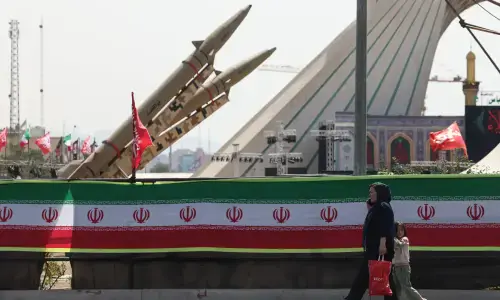
“Pakistan cannot afford to add to our difficulties,” Asif said, noting the country has a large Shia population and a shared “difficult border” with Iran. “We will stand by our brothers in Iran.”
When asked if backdoor diplomacy was underway to manage regional crises, Asif said Pakistan is trying to “put some sense into this situation”, which he said would be worthwhile for both Islamabad and Tehran.
Published in Dawn, February 19th, 2026