Irresponsible targeting


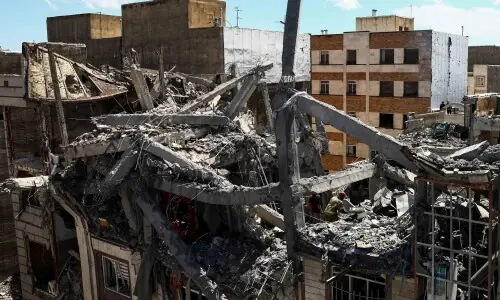
IT is very interesting that, over the years, the US has developed extensive target selection processes to handle combat challenges responsibly during the conflicts it has engaged in — whether under Chapter 7 of UN Charter or through regional arrangements like Nato, or unilaterally. The legal debate on the justification provided for wars started by US have been ongoing. Washington has not escaped criticism for its means and methods employed in these conflicts. However, the recent attacks on Iran shocked everyone for unhesitatingly choosing to target protected persons, civilian infrastructure, political leadership, a girls’ school, a naval ship with no belligerent intentions, factories, nuclear facilities, civilian apartment buildings, oil terminals, boats, the military and political leadership, scientists, engineers, and worse, negotiating officials themselves.
One recalls meeting members of the US JAG (law of war branch) and international humanitarian law experts numerous times at international conferences over the years. The interactions provided valuable insight into the institutional mechanisms of the State Department, Pentagon and the US attorney general’s office. All command levels in the US military must ensure that every strike, every use of ammunition, every target is legally cleared and a distinction made between civilian and combatant; the processes qualify the test of proportionality and make it absolutely necessary to achieve a particular military purpose.
The processes are based on the law of war as painstakingly laid down by experts in The Hague and Geneva in the earlier part of the 20th century. American lawyers supported the ratification of the 1949 Geneva Conventions and several other IHL instruments and the US government went ahead with it, thereby taking upon itself the duty to adhere to all the laws of war in any international armed conflict it engaged in or faced. Later, these commitments were codified by the government in the Law of War Manual spread over 1,100 pages. The US War Crimes Act, 1996, criminalises grave breaches of the Geneva Conventions, making individuals like members of the US armed forces, their field commanders and those up the chain directly liable.
It may sound unreal but the US army’s JAG branch engages around 4,000 to 5,000 lawyers who specialise in combat best practices and rules of engagement. These thousands of lawyers are trained in IHL principles. Additionally, hundreds of IHL specialists work for the joint staff legal offices and the JAG headquarters of the army, navy and air force. Additionally, around 500 lawyers work in 11 combatant commands operational across the globe. We are not counting the over 200 attorneys in the office of the legal adviser in the state and justice departments.
The norms of war are built on restraint, not reciprocity.
With this extraordinary combination of legal experts in various branches of the US government, in walks the defence secretary, whose office has now been rebranded as the Department of War. Waving his hands, he declares these laws and the defence department’s war manual are “stupid rules of engagement” — the very rules the US JAG had prepared, drafted and upgraded many times. He also authorises strikes that violate these rules of engagement and pushes for “violence of action” and announces “no quarter” for leaving combatants alive.
He is believed to have advised American soldiers to ignore legal guidance regarding combat limitation. Unfortunately, President Donald Trump is no less callous and keeps talking about ‘taking out’ (assassinating) Iran’s religious leadership, its political office-bearers and military commanders, not realising that his statements and those of his other colleagues are implicating the US state in a series of intentionally wrongful acts it is admitting itself. It has been rumoured that Israel or the US may explore the Samson option or use of nuclear weapon against Iran. The International Court of Justice had ruled in 1996 that it is not the possession but the actual use of nuclear weapons that is a grave violation of IHL as its effects are indiscriminate and lead to unnecessary sufferings. That verdict continues to hold the field.
The Iranian Red Crescent reports that over 85,000 civilian units have been damaged or destroyed. It would be like damaging or destroying the entire infrastructure of a city like Salt Lake City, Richmond or Newcastle upon Tyne.
The most regrettable part pertained to the negotiations, that were being carried out in utter bad faith — deceiving and attacking the Iranian side when it was less guarded on account of the negotiations. And this, not once but twice. Worse, the US and Israel killed many among the very leadership they were negotiating with. Iranians see in this a renewed obligation reminiscent of Bait-i-Rizwan where the believers vowed that war would be imposed as penalty for allegedly killing the envoy sent to the other side for negotiations.
It is reassuring that Iranian officials have relied on self-defence as stipulated in Article 51 of the UN Charter to frame their responses to attacks on Iranian soil. Iran argues it is entitled to strike targets (in particular, American bases) in the Gulf states, which are perceived as facilitating US or Israeli operations. Iran seems to rely on the right of self-defence alongside lawful reprisals that permit striking back though subject to strict conditions of proportionality, necessity and time lag, and aimed only at military objects.
Iran has also demanded compensation or reparation for damage inflicted by the US-Israel operations. There is a bilateral precedent. Following the 1979 Revolution and the subsequent hostage crisis, the Iran-United States Claims Tribunal was established in The Hague under the Algiers Accords. For decades, the Tribunal adjudicated claims by both governments and private parties, awarding compensation for expropriation, contract disputes, and violations of international law. The Tribunal’s existence demonstrates that Iran and the US already possess a functioning legal framework for compensation.
The norms of war are built on restraint, not reciprocity. Violations by one side (the US and Israel) do not free the other (Iran) from its obligations towards GCC states. Neither treaty law nor Islamic doctrine permits the abandonment of humanitarian protections. In a conflict where cycles of retaliation have too often overshadowed legal principle, the norm remains clear.
The writer is a former caretaker federal law minister and a public international law practitioner.
Published in Dawn, March 28th, 2026