• Tehran presses bloc to condemn ‘illegal expansionism’ by US, Israel
• Row comes after Israel-UAE claims over Netanyahu’s wartime visit
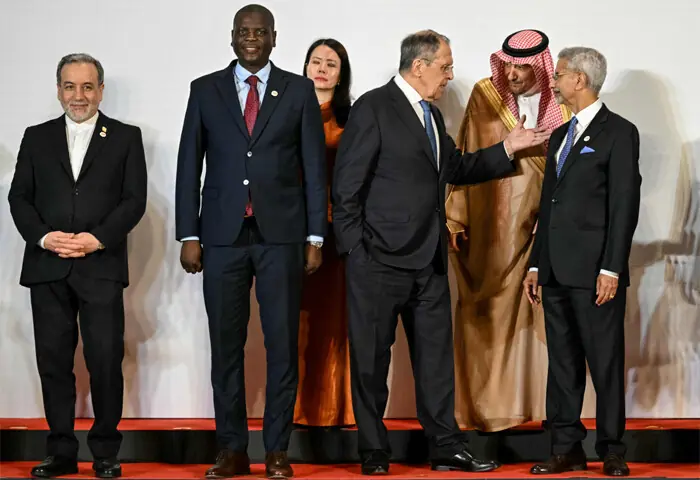
DUBAI: Iran’s foreign minister on Thursday accused the United Arab Emirates of direct military involvement in the US-Israeli war on his country, a sharp public rebuke during a multinational summit that exposed a deep rift among the Brics group of nations.
The spat during the meeting of emerging economies in New Delhi marks a rare moment of direct confrontation, with both Iranian and Emirati officials in the same room since the conflict began. The accusation threatens to derail a joint communique from the bloc, which operates by consensus.
“I didn’t name the UAE in my [Brics] statement for the sake of unity. But the truth is that the UAE was directly involved in the aggression against my country,” Iranian state media quoted Foreign Minister Abbas Araghchi as saying.
“When the attacks started, they didn’t even issue a condemnation.”
Araghchi’s comments were reportedly in response to remarks by the Emirati representative, Deputy Foreign Minister Khalifa Shaheen Al Marar, though Iranian media did not specify what he said. The foreign minister later doubled down on the accusation in a post on the social media platform Telegram.
“The UAE is an active partner in this aggression, and there is no doubt about it,” he wrote.
The recent war began with US and Israeli strikes against Iran on Feb 28, with Tehran responding by firing missiles and drones at US bases and other targets in allied Gulf countries.
The diplomatic firestorm in New Delhi comes just a day after the UAE denied a statement by Israeli Prime Minister Benjamin Netanyahu that he had secretly visited the Gulf nation during the war.
Araghchi had previously warned that “those colluding with Israel to sow division will be held to account”. Addressing the summit, he argued that alliances with the United States and Israel provided no security for the UAE and urged it to reconsider its policies toward Tehran.
“We must live side by side in peace, and this requires peaceful relations and complete understanding between the two countries,” Araghchi added.
Recent reports have fuelled Iran’s allegations. The Wall Street Journal published a story on Monday stating that the UAE carried out its own military operations on Iran in early April. Additionally, Western and Iranian officials have said that Saudi Arabia has launched numerous, unpublicised strikes against Iran. The tension between the two member nations cast a pall over the Brics meeting.
Iranian media have raised doubts about whether a final communique will be issued. Deputy Foreign Minister Kazem Gharibabadi was cited as saying there were “problems and communications” due to the UAE’s presence.
In his formal address, Araghchi urged the Brics+ grouping — which includes Brazil, Russia, India, China, South Africa, Egypt, Ethiopia, Indonesia, Iran and the UAE — to condemn the actions of the United States and Israel.
He positioned his country as a “victim of illegal expansionism and warmongering” and called on members to resist “Western hegemony and the sense of impunity that the US believes it is entitled to”.
“Iran therefore calls upon Brics member states and all responsible members of the international community to explicitly condemn violations of international law by the United States and Israel,” he said.
The conflict has had severe economic and security repercussions, particularly for maritime trade. Host nation India is one of the parties most affected by Iran’s effective closure of the Strait of Hormuz.
Indian Foreign Minister Subrahmanyam Jaishankar highlighted the precariousness of the situation. “Continuing tensions, risks to maritime traffic, and disruptions to energy infrastructure highlight the fragility of the situation,” he said. “Safe and unimpeded maritime flows through international waterways, including the Strait of Hormuz and Red Sea, remain vital for global economic well-being.”
Jaishankar also noted the “increasing resort to unilateral coercive measures and sanctions inconsistent with international law”, without naming any country.
“These unjustifiable measure measures disproportionately affect developing countries and cannot substitute dialogue, nor can pressure replace diplomacy,” he said.
Published in Dawn, May 15th, 2026