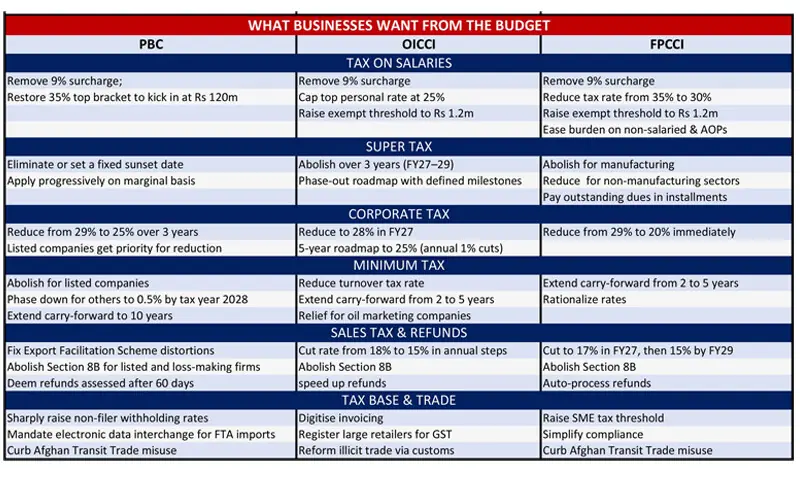

If the entire budget could be consolidated into one universal demand, it would result in lower taxes. The Overseas Chamber of Commerce and Industry (OICCI) is Pakistan’s premier body of foreign investors. The Pakistan Business Council represents the large formal sector, and the Federation of Pakistan Chambers of Commerce & Industry (FPCCI) is the apex body representing Pakistan’s trade, industry, and service sectors.
Broadly, all three organisations acknowledge the necessity of going through the stabilisation process. But they also point out that Pakistan’s tax rates and import tariffs are among the highest in Asia.
Counterintuitively, higher taxes do not result in higher revenue generation for the Federal Board of Revenue (FBR). The higher the tax rate, the greater the incentive to avoid paying taxes, and the lower the tax collection. As PBC points out, nearly 40pc of Pakistan’s GDP is undocumented, with currency in circulation standing at Rs11 trillion in mid-April.
OICCI, using FBR data, says that only about 5.2m people in a population of over 240m filed tax returns in 2023. That is less than 2.2pc of the population. And the ones paying taxes are paying a higher rate of tax than, say, their Indian counterparts. No wonder there is a scramble to leave the country by anyone who can.
Furthermore, lowering direct taxes allows people to have more money in their wallets, which they can then spend on goods and services. Given the high incidence of indirect taxes, lower direct taxes still increase tax revenue through indirect taxes.
According to the OICCI, increasing the taxable threshold from Rs600,000 to Rs1.2 million may result in a short-term reduction in revenue. However, it is expected to boost consumption by approximately 0.5pc to 1pc of GDP.
Then there is the wealthy diaspora who have overseas assets. The high capital value tax rates cause Pakistanis to renounce their nationality rather than continue paying taxes, further reinforcing the cycle of local investors unwilling to invest in Pakistan, much less foreign entities.
FPCCI points out that Pakistan’s fiscal framework is short-term-oriented, aiming to meet immediate targets while ignoring the long-term implications of chasing growth, which in turn reduces overall tax revenue.
The government’s entire tax regime seems focused on auditing high taxpayers rather than bringing new players into the net. A level playing field with rationalised taxes could be the single most galvanising force to revive the economy.
Published in Dawn, The Business and Finance Weekly, June 1st, 2026