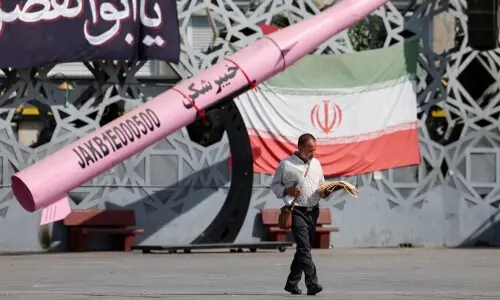
FOR some time, the escalating confrontation between the US and Iran has been playing out round the strategically vital Strait of Hormuz. Both states want to manage the international waterway, which has a key role in global trade, particularly in the transport of hydrocarbons. Tensions flared last week when the Iranians attacked ships using a route they had not ‘authorised’.
From that point onwards, both the US and Iran have traded regular fire, with hostilities rising, and the Islamabad MoU coming under a cloud. The US has hit Iranian facilities close to the coast, as opposed to the heavier bombing across the country before the April ceasefire. Tehran has responded by hitting US bases and infrastructure from Jordan to the GCC states. On Monday, American President Donald Trump declared, in all caps, that his country would be the “guardian of the Hormuz Strait”, while adding that the blockade of Iran would resume. Tehran, meanwhile, says the strait has been closed.
None of this bodes well for peace in the Gulf, and if the brinksmanship continues, a return to full-scale war is inevitable. There can be little doubt that the roots of this crisis lie in the unprovoked US-Israeli aggression against Iran. Both these states thought they had played a masterstroke by eliminating Iran’s top civilian leaders, such as Ayatollah Ali Khamenei and Ali Larijani. Perhaps they thought these assassinations would cause the Islamic Republic to implode. However, in their hubris, Washington and Tel Aviv may have actually killed any chance of compromise with Tehran, clearing the way for hard-line factions within Iran, led by the Pasdaran, to get in the driver’s seat.
Though the late Khamenei was a top cleric, ideologue and dyed-in-the-wool revolutionary, he maintained a cautious balance in foreign policy. Similarly, Ali Larijani was a pragmatic, seasoned player who could have steered his country towards a dignified exit from the war. But today, many of those around the new supreme leader, particularly IRGC commanders, apparently believe in an ‘eye for an eye’ when it comes to the US and Israel, and do not appear to favour the diplomatic process. The counterattacks on US allies in the region support this observation.
In order to save the peace process, Iran’s political class need to take control of the narrative. Moreover, there must be flexibility within the Iranian establishment towards the Hormuz question, where national interests are balanced by the rights of fellow littoral states and the international community. For its part, the US should halt all attacks on Iran if the MoU is to be saved. It is incumbent on regional countries to clearly inform the US that further escalation will lead the entire Middle East towards a destructive new phase of the war.
Published in Dawn, July 14th, 2026