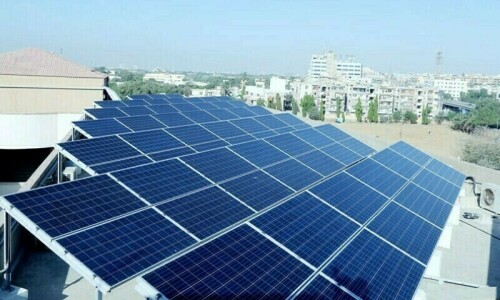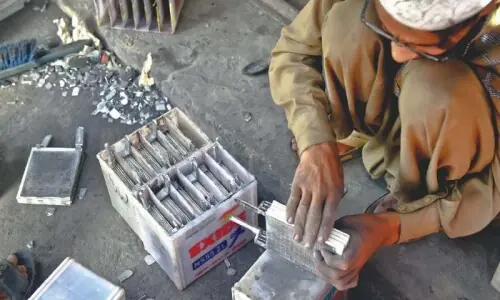
Pakistan’s battery imports went from 1.43 gigawatt-hours in 2024 to 4.59 gigawatt-hours in 2025, amounting to $36 million. The solar boom is now being followed by early green shoots of a battery boom.
Battery prices globally have been consistently declining, from $137 per kWh in 2021 to $105 per kWh in 2026. As demand continues to increase, its price will decline, eventually leading to a further surge in demand for batteries and creating a self-perpetuating loop that we have seen with solar panels and other electronic equipment over the years.
Consumer surplus recipe
There are no subsidies or government incentives; it is just the market clearing itself out, as households buy batteries because they have surplus solar power in the morning, which can be used to charge them for later in the evening. A perfect recipe for consumer surplus, and a disaster for an inefficient grid.
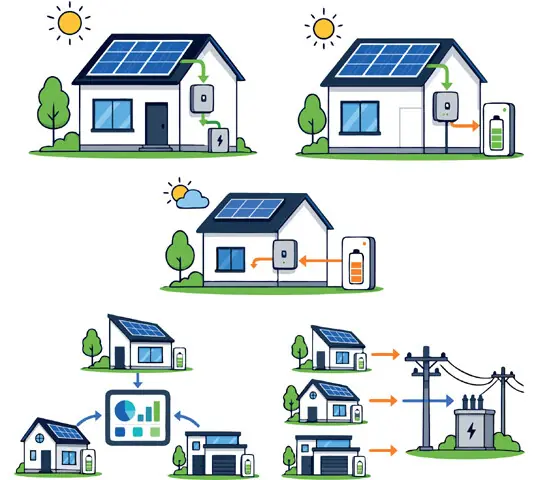
This can result in a Virtual Power Plant (VPP), which is not a single facility but rather thousands of household and small-commercial batteries. Together, these units can be networked so that a system operator can operate them as a single, dispatchable block. One battery can be deemed as a backup, but ten thousand batteries, coordinated, are a power station. The difference lies entirely in whether they are orchestrated or not.
The current power model will continue to fail without accounting for changing ground realities of solar
Peak power demand in Pakistan occurs in the same three-hour window, 7pm to 11pm, in every one of the last 26 months, without exception. As solar continues to gain traction and demand from the grid falls, peak demand for the grid remains in late evening, driven by residential and commercial cooling load.
In that window, the marginal cost of the last unit of electricity dispatched swings between roughly Rs10-40 per kilowatt-hour (kWh) depending on the month, averaging around Rs18 per kWh. This is two to three times the average fuel cost, because what is actually being paid for at that hour is largely capacity costs, not fuel.
Effectively, the grid is mostly used for four hours, while for the rest, it just exists; while capacity is paid for all hours.
A decade ago, before the solar revolution, fuel costs accounted for most of electricity tariffs. To avoid past pitfalls, it is crucial that any planned additional capacity accounts for future battery and solar installations. Pretending battery adoption is not taking place is a fallacy that may cost us hundreds of billions in the future, as capacity costs continue to rise.
An existing battery fleet, decentralised, without dedicated capacity payment and guarantees, is consideraly cheaper for the economy. It can be charged while the sun shines and the grid is slack and discharged during the evening peak, when the marginal unit is at its most expensive.
Connecting enough households and small businesses would ensure that during peak hours, the grid does not have to buy from the last, costliest plant on the merit order. This effectively is the entire mechanism that Pakistan’s tariff and planning architecture has simply not been built to capture.
A virtual power plant is a network of thousands of household and small-commercial batteries that a system operator can operate as a single, dispatchable block
Strengthening energy security
However, this mechanism has a ceiling. Modelling this system shows the wholesale price-suppression value of VPP capacity flattens sharply once installed capacity crosses roughly five to six gigawatts. Beyond that point, adding more batteries barely moves the peak-hour price because the most expensive plants on the merit order are already being displaced.
This matters because, given the current learning curve and battery imports, Pakistan may have more than 8GW of battery capacity, well past that saturation point. The case for going that far cannot rest on price compression alone but also on the displacement of imported fuel, thereby strengthening energy security.
The blockade of the Strait of Hormuz did not cause a crisis locally given the sheer growth in solar capacity over the years. If the same had happened a few years back, there would have been six to eight hours of rolling load-shedding and a massive balance-of-payments crisis.
Through a distributed solar infrastructure, Pakistan avoided RLNG imports of roughly $700m in the last six months. If battery imports continue at this rate, by 2030, solar could displace 6 GWh of grid generation annually that would otherwise be met by imported RLNG and coal.
Pricing fairness
None of this works for consumers unless the price paid for their exported flexibility is fair and the necessary infrastructure exists to support it. Pakistan’s experience with net-metering solar is the cautionary tale here, where political rather than economic realities drove export prices.
A VPP buyback framework needs to be institutionalised quickly to crowd in battery capacity and reduce imported fuel and surcharges in the process. Discos need to be equipped to initiate pilots in battery-dense areas through such infrastructure.
This is how the transaction would work: a household with surplus solar capacity charges its batteries during the day, “committing” to sell a predetermined quantity in the evening, just as they do with solar. The household gets paid for the stored kWh, while the grid avoids buying expensive imported kWh from power plants. Learning from the net-metering saga, the price at which the grid buys from households needs to be fair and linked with marginal prices.
Batteries will continue to gain stronger footing in the system, and there will be grid defection in the evening as battery adoption increases. However, whether the grid can be fast enough to capture this opportunity remains to be seen. The market will clear itself out; a cost-plus anachronistic approach to tariffs may fail again.
The deeper shift this all points to is in how Pakistan plans generation at all. The thought process is anchored around centrally dispatched plants, and treats distributed batteries, if at all, as a rounding error. That planning model was built for a grid in which all the capacity is concentrated in a handful of visible power stations. It is the wrong model for a grid where a meaningful share of new capacity is arriving one household battery at a time, invisibly, driven by import data rather than a plan that cannot keep pace with technological advancements.
The batteries are coming regardless of whatever central planning assumes. The only real choice left is whether Pakistan designs a market to use them, or keeps paying peaker-plant prices for a problem households have already almost solved on their own.
The writer is an assistant professor of practice at IBA and CEO of National Credit Guarantee Company Limited.
Published in Dawn, The Business and Finance Weekly, August 24th, 2026