TURKIYE is Muslim. We know that. What kind? Ottoman? Do today’s Turks not stand de-Ottomanised? Ataturk had forced all royal Ottomans out of the country. And such was the power of Ataturk’s secularisation of state and society that Ottoman became a bad word.
The problem is history. It began in Central Asia when Changez Khan’s depredations made the Oghuz tribesmen — the harassed ancestors of today’s Turks — move to western Anatolia for safety. Little would they know what glory awaited them in (one) western Anatolia, (two) in the Balkans, (three) in Southern Europe, (four) in Central Europe, (five) in Northern Europe, (six) in the Maghreb, (seven) in the ‘upper’ Middle East — from Iraq to Morocco — and finally (eight) in the Arabian peninsula.
Also extending the Ottoman Empire to the confluence of the Mediterranean and the Atlantic was corsair Khairuddin Barbarossa. Turks also took the Crimean Khanate as a vassal state. With the Black Sea and the Dardanelles already under Ottoman control, Turkiye had all the strategic waterways at its disposal. Today, the Turks take pride in the fact that the Ottoman Empire was the only empire which had within its realm four cities which have no parallel in terms of imperial glory and religious sanctity — Makkah, Madinah, Jerusalem and Constantinople.
Ataturk’s emphasis on Europeanisation was essentially a political move and was designed to emphasise to the peninsular Arabs and to his own people a ‘de-fraternisation’ process with the Arabs because of their revolt in support of the British-led Allies against the Ottoman government during WWI. The revolt was led by no less a figure than Hussain bin Ali, the Sharif and Emir of Makkah, appointed by the Ottoman sultan. This anger against the Arabs stayed for a while, for Turkiye was amongst the countries which were quick to recognise Israel. (Decades later, a Turkish president, Recep Tayyip Erdogan, would seek a warrant of arrest for Israeli Prime Minister Benjamin Netanyahu for genocide in Gaza.)
Initially, the Turkish people could understand the reason behind Ataturk’s Europeanisation. However, after his death a section of the intelligentsia began to question what to them was an over-emphasis on Europeanisation. Soon, this found its way into politics and parliament, with the first opposition party, the Democratic Party, founded in 1946, assuming power in 1960. There is no space for details, but the army, considering itself the guardian of Ataturk’s legacy, overthrew the civilian government and hanged the first democratically elected prime minister, Adnan Menderes, after a bogus trial. (Pakistan had offered asylum to Menderes, but the Turkish military rejected it.)
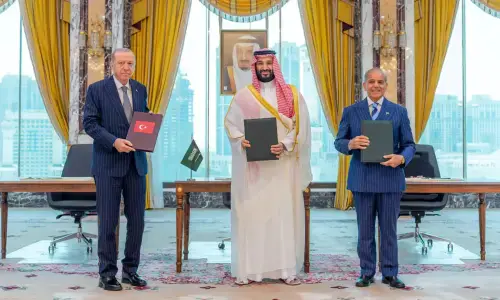
Turkiye’s military pact with Saudi Arabia and Pakistan is astonishing.
In analysing Turkiye’s role in world affairs today, we have to ignore the decades preceding Erdogan’s entry into politics with his arrest in 1999 for reciting a politically provocative poem. He became prime minister in 2003 and president in 2014. What is astonishing today is Erdogan-led Turkiye’s plunge into a pan-Islamic military relationship with Saudi Arabia and Pakistan. According to the Makkah Defence Alliance, an attack on any of the three countries will mean an attack on all of them.
So far Riyadh had avoided treaties of this nature and was mindful of its commitments to the US. To create a soft image for itself it encouraged arts and entertainment, and organised international sports events. The three-power pact, however, has created a new image for Saudi Arabia — that of a military power. In its editorial, Dawn saw the treaty against the background of the US-Iran war and called it a “symbolic pact.” One must congratulate the genius who thought of the three-power pact, because none of them really expects an attack from a fourth country. Pakistan knows India is aware of the China factor and limits its mischief against Pakistan as the conflict in May 2025 shows. Turkiye is a Nato member, and attacking it means provoking the world’s strongest military alliance.
What conclusions do we then draw from this poser? Frankly, two of the three powers — Saudi Arabia and Turkiye — have a triumphant grin. They seem to think: “Look, we are great on our own. We are not appendages. We do not need others for survival.” The alliance’s official stance is that it’s a defensive pact according to Article 51 of the UN Charter. The Saudi government also betrays a feeling it had for long — that it was not satisfied with America’s security guarantees against Iran. More problematic are rockets fired by Iran on American bases in Saudi Arabia. There are other complicated issues, like Pakistan’s nuclear assets. Is it the duty of the other two partners to ensure their security? The joy over the three-power pact disappears when you consider its implications.
The writer is Dawn’s External Ombudsman and an author.
Published in Dawn, September 4th, 2026