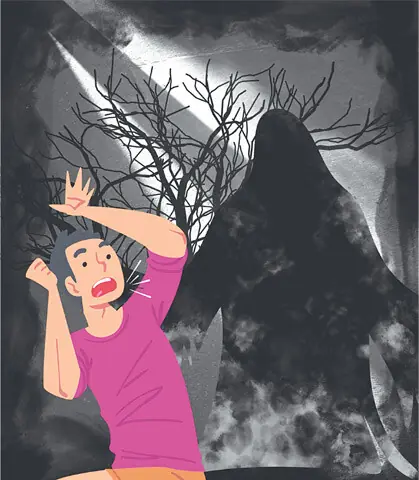
Last night, I was lying on my bed reading a magazine when suddenly the lights went out. It wasn’t the time for load-shedding, so the unusual pitch-blackness took the life out of me. Since childhood, I’ve been scared of the dark, and this unexpected blackout just made me panic.
Before I could get my phone and turn on the torch (to whoever invented this feature, thank you so much!), I heard a creak. My family says I am chicken-hearted, so it was natural for me to imagine the scariest possible scenarios. To me, that creak was a sign that something was there in the room — something I couldn’t name. Not a monster, not a ghost, but something eerie…
I panicked even more and fumbled around on the bed. I touched something soft and screamed a little (although it was just my plushie). The next second, I found my phone. I was shivering, my heart was racing and fear had completely taken over. All of this happened in maybe five or six seconds.
I turned on the torch. The room looked scary, with huge shadows falling on the walls because of the torchlight. I got up and took quick steps towards the door. Those few seconds between getting off the bed and reaching the door felt like hours. I felt as if I would never get there, as though something wouldn’t let me. Like in a horror movie, where the character is running away from something.
Is the dark really scary, or is it what we imagine hiding in it? Let’s switch on the light and find out why we’re afraid of the dark
But I did reach the door. I opened it and saw my siblings running around and laughing. I let out a sigh of relief.
I’m sure a lot of you can relate to this. It is called the fear of darkness and the unknown. So, today, I am going to face my fear and discuss why we get scared of things we cannot see or explain, and why sometimes our imagination makes it worse.
What makes darkness scary?
Darkness means no light. Your eyes cannot see properly, and when you cannot see, your brain starts guessing. It begins to imagine what could be there. Suddenly, an ordinary room can feel like the scariest place in the world.
My room, in daylight, is just a normal room with a bed, a cupboard, a pile of clothes on the chair, a lamp and my cute teddy resting on the side table. But once the lights are off, apparently that same pile of clothes becomes ‘something’ or ‘someone’ sitting there. The teddy becomes a small, strange-looking figure, while the cupboard turns into a gigantic, mysterious structure.
And if you say it out loud, it might sound a bit silly. People might even laugh at you. So, why does this happen?
I did some research and found that there are reasons why humans can feel uncomfortable in the dark. For our ancestors, darkness probably meant danger because they could not see what was around them. A wild animal could approach without being noticed, or an enemy could hide nearby. Being able to see what was around you meant being better prepared to react to danger.
Perhaps that is one reason why darkness still makes us uncomfortable. When we cannot see what is around us, our brains have less information to work with, so our imagination takes over. In other words, sometimes the real fear is not the darkness itself, but not knowing what is in it.
The things hiding in the dark
This also made me think about how much of our fear comes from what we learn from the people and things around us — our parents, family, books, films and television.
I’ve actually seen something like this in a family I know. The parents never really talked to their children about ghosts or monsters. They didn’t show them scary films or tell them frightening stories either. The children grew up without being told that there were things to be afraid of at night.
As a result, the dark never really meant anything scary to them. They knew it was simply… dark.
Perhaps it isn’t really the dark we are afraid of, but what we have learnt to imagine in it. If a child grows up hearing ghost stories, watching scary films and being told about things that come out at night, darkness can mean something very different to them.
So, what exactly does your brain fill that gap with?
The answer can depend on where you grow up and what you hear around you. Different cultures have their own stories about things that cannot be seen. In one family, it might be a story about a ghost near a graveyard. In another, it might be a warning not to sit under a tree after dark. In other parts of the world, there are stories about spirits, haunted houses, strange creatures and mysterious roads.
The stories are different, but the basic idea is often the same: something is out there, we can’t see it and it might be watching us.
Scary things, now online
The internet has given this old fear some very new forms.
There’s the Backrooms, an endless stretch of empty, yellow-lit rooms that exists as an internet legend. Somehow, that idea alone has inspired thousands of videos and games. There’s analogue horror, with clips made to look like old, damaged recordings of something that shouldn’t exist. Then there are hundreds of TikToks of a shadow near a doorway, captioned “Can someone explain this?”, with a comment section split between “obviously fake” and “I’ve felt this too”.
The interesting part is that these aren’t really new fears. They are simply new ways of presenting the same old fear: something is there, but we don’t know what it is.
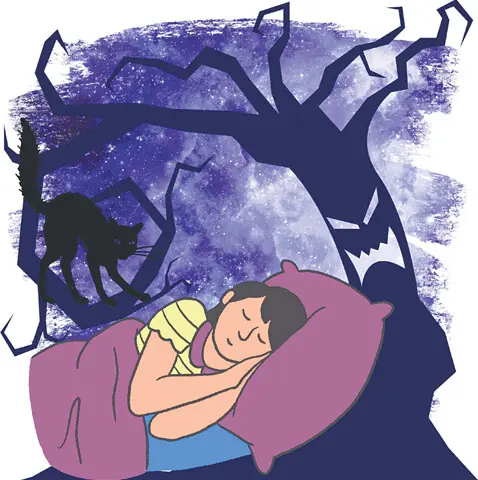
When you know there’s nothing there
This is the funny part. You can know one hundred per cent that the sound you are hearing is actually the fan. You can turn on the light and see with your own eyes that the ‘shape’ is just a pile of laundry on a chair. Yet your heart may still be beating as if you have just run a marathon.
Your brain may figure out what is happening very quickly, but your body can take a little longer to calm down and realise that everything is okay. And think about all the stories you have heard and all the scary things you have seen. Isn’t all that somewhere in the back of your mind when you hear a strange sound or see something in the dark?
If you had never been told about all that scary stuff, would you react in the same way? Maybe not.
So should you reject it all as myths?
There are things we don’t have answers to, but that doesn’t automatically make them supernatural. Sometimes, we simply don’t know what caused a strange sound, a feeling or something we saw from the corner of our eye. There is an explanation for it; it’s just that we don’t know it.
Maybe that is where we need to be a little more careful. We don’t have to laugh at someone because they believe they experienced something strange, but we also don’t have to immediately decide that it was a ghost. There is a big space between saying “It was definitely supernatural” and “It was definitely nothing”.
So, if you ever hear a strange noise at night and your mind starts turning it into a ghost, a monster or something watching you, stop and think. It could simply be the rustling of leaves outside, a charger wire hitting a chair, a stray cat, a neighbour moving around or something falling in another room.
Yes, use a little logic. You are not playing the lead role in a horror movie, and not every strange sound needs a scary explanation.
When something feels real
Not every strange thing we experience at night is our imagination. Sometimes something actually is happening to our body or brain, but we don’t understand what it is.
Here are some eerie experiences that people have often related to a supernatural presence or phenomenon, whereas in reality, they have a perfectly normal explanation.
Sleep paralysis
Sleep paralysis is a real thing. Almost all of us have experienced it at least once in our lives. In this condition, your brain is awake, but the part of your body that controls movement is still in sleep mode, which is why you can feel awake but still be unable to move.
Some people also feel like someone or something is in the room, or feel pressure on their chest, as if something is sitting on them.
Hypnic jerk
When was the last time you felt like you were falling from somewhere while sleeping and your brain woke you up with a little jerk? This is called a hypnic jerk. It happens just as your body relaxes and your brain shifts from being awake to being asleep.
Sometimes, this sudden relaxation can give your brain the sensation that you are falling, causing your muscles to jerk suddenly and wake you up. It is completely normal and happens to all of us.
Pareidolia
Pareidolia is when we imagine faces, figures or other familiar shapes in things, especially in the dark, even though there is nothing like that actually there.
For example, a pile of clothes might look like a person sitting in a chair, or two marks on a curtain might look like a pair of eyes. Your brain sees the shape but cannot make out exactly what it is, so it tries to make sense of it. Sometimes, what it comes up with can be a little scary.
Hearing things while falling asleep
These are called sleep-related hallucinations and can happen when your brain is moving between being awake and asleep, which means your senses are not working in quite the same way as when you are fully awake. During this transition, your brain can produce a sound from a dream-like experience before you are completely asleep. — M.A
Published in Dawn, Young World, September 12th, 2026