Saudi Arabia says Iraqi drones forced temporary closure of crucial oil pipeline

Saudi authorities said on Friday drones launched from Iraq led to the temporary closure of a crucial oil export route used to bypass the lockdown of the Strait of Hormuz.
Riyadh has increased its use of the East-West pipeline, which links Abqaiq, near the Gulf, to the port of Yanbu on the Red Sea, since the start of the Middle East war to bypass the closure of the Strait of Hormuz by Iran.
The Saudi foreign ministry condemned “the targeting of the East–West pipeline in the Riyadh and Medina regions by several drones coming from Iraq, which caused human injuries and damage”.
“The pipeline was stopped as a precaution, and the attacks resulted in some injuries,” an energy ministry official told the SPA news agency earlier.
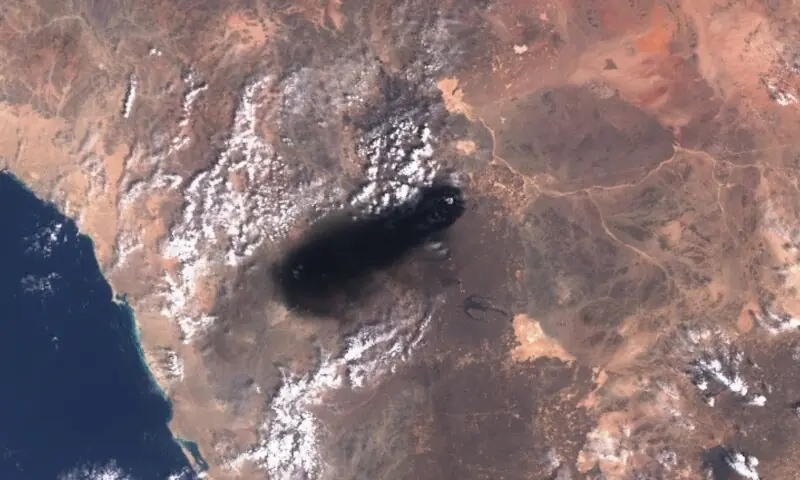
Satellite images from Copernicus Sentinel Data taken on Thursday showed black smoke billowing near Madina, along the general route of the East-West pipeline that carries Saudi oil to its Red Sea coast.
The office of Iraqi Prime Minister Ali al-Zaidi confirmed the attack originated from Iraqi territory and said on X that the commander in charge of the southern province of Maysan had been dismissed.
The Iraqi government said it condemned “the attacks targeting our brethren in the Kingdom of Saudi Arabia originated from a location within the governorate”.
‘Dangerous escalation’
Riyadh said that, at the Iraqi prime minister’s request, it had chosen “not to respond at this stage and to support the efforts of the Iraqi government … to prevent attacks launched from Iraq against the Kingdom and neighbouring countries”.
Riyadh previously accused Iraqi militias of targeting its oil infrastructure.
But it stressed that the kingdom “reserves the right to take all necessary measures to protect its sovereignty, its security, its facilities,” and its people.
Bahrain, Jordan and Qatar also condemned the attack on the Saudi pipeline, while the Gulf Cooperation Council denounced “a dangerous escalation and an unacceptable threat to the security of the Kingdom”.
Oil prices have climbed past $100 a barrel this week, while average US diesel prices topped $6 for the first time on Friday — a potential headache for President Donald Trump ahead of midterm elections.
Houthi rebels announced a maritime blockade in July against Saudi Arabia — which supports the Yemeni government — attacking its oil tankers in the Red Sea.
By taking control of the Yemeni Red Sea coast and the islands in the Bab el-Mandeb Strait on Friday, the Houthis consolidated their grip on the strategic passage linking Europe and Asia.
Navigation through the Bab el-Mandab Strait was “safe” for all but Saudi Arabia following the latest advances, the Houthis said.
Pakistan condemns attack on pipeline
Separately, the Foreign Office (FO) issued a statement condemning the “reprehensible drone attacks” on the pipeline.
“These attacks and targeting of civilian infrastructure are a flagrant violation of the international law as well as sovereignty and territorial integrity of the brotherly kingdom of Saudi Arabia and pose a serious threat to regional peace, security and stability,” the FO said.
“Pakistan reaffirms its unwavering support for the sovereignty, territorial integrity, security and prosperity of the kingdom, and reiterates its solidarity with the leadership, government and brotherly people of Saudi Arabia,” it said.
“Pakistan has been and will continue to make earnest efforts for achieving lasting peace and stability in the region,” the statement concluded.
In August, Pakistan, Saudi Arabia and Turkiye signed a defence pact, aiming to strengthen collective deterrence and empowering its signatory states to treat an attack against one of them as an attack against all of them.
Earlier this week, Defence Minister Khawaja Asif cautioned that agreement could become operational if there was a “spillover” of the conflict in Yemen into Saudi Arabia.
The FO, however, said on Thursday rejected speculation that Pakistan was considering joining Saudi Arabia in military strikes against Houthi targets in Yemen, saying the newly signed was still being firmed up and should not yet be viewed in terms of its operationalisation.