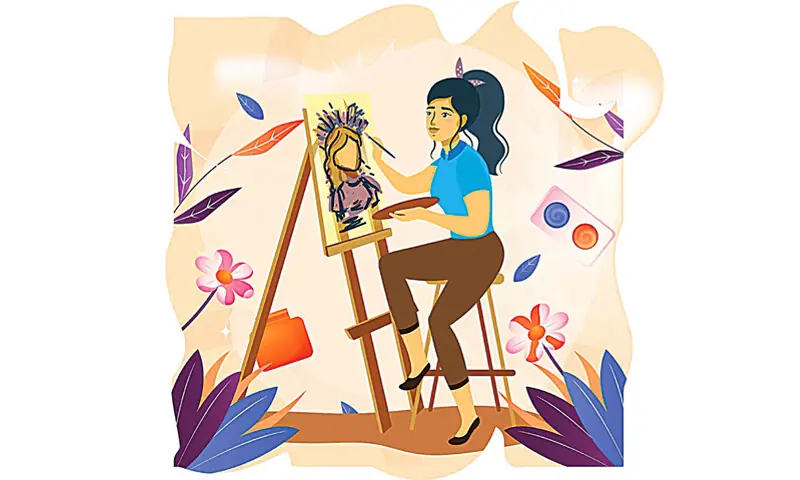

“What are you doing, Naimal?” her mother asked on seeing Naimal with paintbrushes in her hand, her clothes dirty and her hair loosely tied into a ponytail. Naimal stood engrossed in the canvas in front of her.
“Mama, I am painting,” Naimal said, lost in her thoughts. To Naimal, painting was like therapy for her boring and exhausting life.
“Naimal, Sufiyan is studying; you should also focus on your studies more. Otherwise, when exams come, you will be crying as always,” her mother said, which felt deeply discouraging to Naimal.
“Mama, I only cried once during my last exams, and that was because I took them with a high-grade fever,” Naimal argued.
The debate had started because Naimal had just told her mother that she was going to participate in another art competition. Like many traditional parents, Naimal’s mother thought she was wasting time on hobbies, instead of putting her time to better use.
When her mother left, Naimal cried alone in her room. Art was her therapy, and she felt empty whenever she thought about giving it up. She wondered if studying all the time was really the answer. The human brain needed rest and relaxation too
“If you dedicate all your efforts to your studies, your grades will improve. Also, I can see that your extracurricular activities are increasing day by day. Remember, ‘nothing’ except studies and grades are important for children your age. To be successful, you need to study. These are all distractions, not competitions,” her mother scolded.
When her mother left, Naimal cried alone in her room. Art was her therapy, and she felt empty whenever she thought about giving it up. She wondered if studying all the time was really the answer. The human brain needed rest and relaxation too.
Naimal kept thinking, “If studying more is the only way to improve my grades, then why haven’t they improved yet? I already spend so much time studying. How much more can I do?”
This was not the first time Naimal had felt this way. When she was an average student, no one bothered her much. But as she started taking part in more extracurricular activities to build her confidence and learn new skills, the criticism increased.
When Naimal discovered her love for art, she won competitions and received recognition for her work. Yet people often told her that she should focus on her studies instead of her hobbies. When those words came from her own family, they hurt even more.
Naimal felt as if all her hard work was being ignored. She knew that students could suffer from burnout, and art helped her relax and feel better when she was stressed.
That night, however, she made up her mind. She would take part in the competition with all her heart, no matter what anyone said about it being a distraction or a waste of time. She filled out the form because the competition was free to enter.
She decided not to tell anyone about her entry. Her exams were also taking place that same week, so she would dedicate specific times to her studies, and art would be her reward after completing her study targets.
She knew she was a talented artist, so thought why not devote some attention to that talent instead of just cramming textbooks? Naimal quietly submitted her entry for the art competition and waited patiently for the results.
A couple of weeks later, while Naimal was studying in her room, her phone rang. It was an unfamiliar number.
“Hello?” she answered.
“Is this Naimal?” a woman asked.
“Yes.”
“Congratulations! Your painting has won second runner-up in the 2026 All Pakistan Art Competition.”
For a moment, Naimal could not believe what she had heard.
“Really?” she asked, her voice trembling with excitement.
“Yes! We’ll be sending you the details about the award ceremony soon. Congratulations once again!”
Naimal ended the call and stared at her phone. Her eyes filled with tears of happiness. She had done it!
Her first thought was to run to her family and tell them the big news, but she stopped. She couldn’t gather the courage. She felt frustrated, thinking no one would appreciate her at home. After all, they considered it just a hobby.
The next day at school, she saw her friend, who was a far more talented artist than her. Naimal told her how she had been feeling all this time. Her friend wasn’t worried. Instead, she shared her own experience with Naimal.
“It happens to me too. You’ll get used to it. But trust me, don’t feel bad about yourself. You may not be naturally gifted academically, and that is completely normal. Some people excel in extracurricular activities or hobbies. Eventually, they may even turn their hobbies into careers and excel in them,” she said.
Naimal understood what her friend meant and felt better.
Extracurricular activities, hobbies and interests are important for young people. They can help build confidence, develop skills and provide a much-needed break from academic pressure. It is time we stopped discouraging children in the name of encouraging them and let them enjoy the things they love.
Academic burnout cannot be prevented by studying all the time. Sometimes, taking a break, pursuing a hobby and doing something that makes you happy can help you return to your studies with a fresh mind.
Published in Dawn, Young World, September 19th, 2026