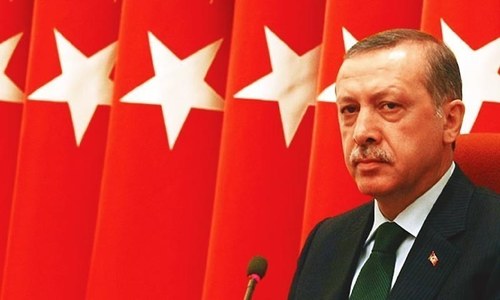
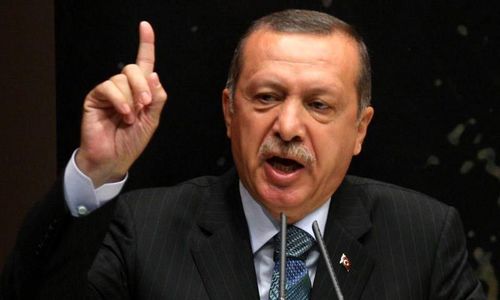
ANKARA: By letting go of his prime minister after just 20 months in the post, Turkey’s President Recep Tayyip Erdogan has shown his iron will to create a presidential system where one man has total authority.
Ahmet Davutoglu, who served as premier since Erdogan became president in August 2014, in his farewell statement vowed undying loyalty to the Turkish strongman and never to utter a “single word” of criticism against him.
But he made clear the untimely end of his mandate, usually four years, was “not my choice but a result of necessity”, in a veiled sign of bitterness.
Davutoglu, foreign minister from 2009 to 2014, is a heavyweight within the ruling Justice and Development Party (AKP) and observers say isolated but serious policy disputes proved too much for Erdogan.
Seeking to leave a historic mark on Turkey after a decade as premier, Erdogan has already transformed the role of president that was largely ceremonial since the 1980 military coup.
His main ambition is now to change the Turkish constitution, possibly through a referendum, to formally enshrine his status as the number one within a presidential rather than parliamentary system.
“President Erdogan has delivered a ‘nobody can stop me’ message,” said Faruk Logoglu, Turkey’s former ambassador to Washington and ex-MP for the Republican People’s Party (CHP).
“He will not hesitate to take steps to change the constitution to bring in a full executive presidential system,” he said.
‘100 per cent loyal PM’
The new prime minister, set to be named at an AKP congress on May 22, is expected to be a far less authoritative figure than Davutoglu who negotiated a historic deal with the EU in March to stem the flow of refugees to Europe.
The Hurriyet daily on Friday listed 20 disputes that had created a rift between Davutoglu and Erdogan, beginning with arguments over whether former ministers should stand trial for corruption and the future of powerful spy chief Hakan Fidan.
The names being floated as the possible new premier include the so-called “three Bs” — Erdogan’s veteran ally Transport Minister Binali Yildirim, his own son-in-law Energy Minister Berat Albayrak and the uber-loyal Justice Minister Bekir Bozdag.
“Whoever gets appointed ... his paramount task will be to ensure that a new constitution legalises Erdogan’s ‘one-man’ rule and is supported through a referendum,” said Kemal Kirisci of the Brookings Institution.
Opposition media blasted what they termed a civilian “coup”, saying Erdogan had effectively dismissed a premier who secured 49.5 per cent of the vote in November elections and 317 seats in the 550-seat parliament.
“There is nothing here to take lightly. It is a ‘palace coup’. Can there be any other explanation?” Nuray Mert of the opposition Cumhuriyet daily wrote in her column.
“A prime minister is not mysteriously unseated in a normal country such a short time after the elections,” she added.
Aykan Erdemir, senior fellow at the Foundation for Defence of Democracies, said that Erdogan wants a prime minister “who will follow his orders 100 per cent of the time” especially on the presidential system which was not a priority for Davutoglu.
“With the appointment of a new prime minister to Erdogan’s liking, there will be a stronger commitment for a presidential system.”
‘Model didn’t work’
To make the constitutional changes, parliament needs to agree the holding of a referendum with a three-fifths majority, or parliament can make them directly with a two-thirds majority.
The 330 votes needed for the referendum are 13 more than the AKP’s current number of seats while the two-thirds majority equates to 367 seats. Thus Erdogan will have either to seek new elections or win over opposition deputies, possibly from the Nationalist Movement Party (MHP), currently in the throes of a leadership crisis.
But conservative commentators and MPs argued the conflict that emerged between Erdogan and Davutoglu — who share views on the need for a strong Turkey and the importance of Islam — showed the need for a presidential system where there is no ambiguity on decision-making.
Senior AKP lawmaker Aydin Unal acknowledged that the model of a “strong president and strong prime minister” had not worked effectively.
“The profile of the prime minister is going to be lower,” he told Haber Turk television.
Published in Dawn, May 7th, 2016