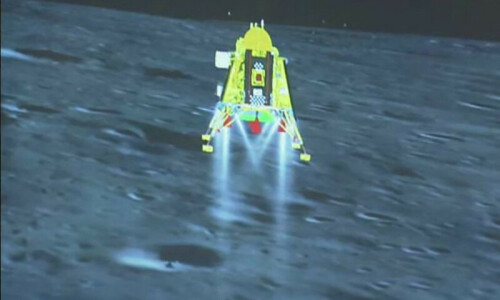
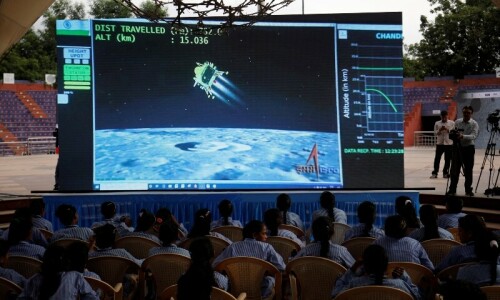
THANKS to a legion of excellent scientists and engineers trained in Indian universities, India is shooting for the stars.
Here ‘stars’ is a metaphor for much else: astrophysics, computers, chemical technology, pharmaceuticals, heavy engineering, process management, etc. On this side, led by blind men, Pakistan is heading for the caves. Its space programme from the 1960s has folded up; there’s not even a plan for the future.
Our universities are a disgrace. These cesspools of intrigue and corruption breed flies, not thinking minds. That every Pakistani institution has been corrupted isn’t breaking news but for sheer depravity, unethicality and incompetence our senior academics — meaning vice chancellors, deans, chairpersons, and professors — take the cake.
I sincerely apologise to the 10 per cent who are honourable persons; this article is not directed towards them. But the rest outdo our politicians, generals, judges, shopkeepers and milkmen.
Is the system so truly broken, so hopelessly dystopic? Let the reader decide after seeing the everyday, real-life examples below. Each has been verified for authenticity. I have mercilessly trashed many which were brought to my attention within the last one year because, though possibly genuine, my informants did not include enough detailed evidence.
One: X and Y are brothers. X became ‘Dr X’ after submitting a shoddy piece of research to the department of chemistry of a local university. Some years later, the younger Y wangled a scholarship and applied to a cow college in the American Midwest. There, no foreign applicant with two legs is ever rejected — nor is any thesis — for those who can pay.
That India succeeds while Pakistan fails in space owes to the different quality of their education.
Fortunately for Y, having Big Brother X’s thesis in hand spared him the sweat and toil of research. Changing the title page, shuffling subtitles, throwing in a dash from here and a smidgen from there, by the grace of God Y became ‘Dr Y’ with a doctorate in materials science and engineering. The story gets even better: today both brothers are vice chancellors of public universities under HEC’s jurisdiction. Maybe, one of them will someday rise to HEC chairman.
Two: Z was mediocre during school days and couldn’t make it to engineering or medical college. Like many other less successful students, he is a Bachelor’s in physics and eventually became ‘Dr Z’. Thereafter he became assistant professor at a university in Lahore. In due course, he applied for promotion to the next higher grade for which he had to submit his teaching portfolio, including course examination papers, to some committee.
I chanced upon the final exam paper set by Dr Z for his introductory physics class. It left me perplexed. Downloaded from the internet, some questions were beyond wrong — they were bizarre. Example: Why is cross price elasticity of demand important? This PhD in physics did not know the question actually belongs to economics! He had set new standards of idiocy but the assessment committee, as always, was generous. Dr Z now flaunts his new credentials as ‘HEC tenured associate Prof Z’.
Three: W hails from a certain mountainous area where scholarship is little known or admired but power and guns are highly respected. In time W became Dr W and then Prof W. He rose yet further to dean and VC of a university in the area. This entitled him to what every Pakistani VC cherishes most — an official Land Cruiser and armed security staff.
Then along came a problem: the university’s faculty accused the VC of kickbacks and corruption in awarding building contracts, making spurious appointments to various faculty and staff positions, etc. In a fit of anger, the VC, accompanied by his armed guards, strode into a group of protesters and hurled vile abuse.
Thereafter 80 teachers signed a petition to the province’s chief minister stating he had threatened to shoot them and added a supportive video. They asked for his removal but no action followed and he completed his tenure. He is presently shortlisted by HEC for the post of VC for other universities.
Four: Dr X and Dr Y are husband and wife in different academic fields but teach in the same city. To fulfil HEC criteria for annual increments and promotion, both need to publish a certain number of research papers yearly. Of course, even junk papers need effort and so normally one university professor scours the internet and copy-pastes, perhaps cooks up suitable data, finds references, and then puts it all together. Co-authorship can be sold for a price but is gratis for friends and when there’s a happy conjugal relationship.
How can persons from very different fields report research in a single paper that bears as many as 10 names? Rarely is the question asked but this time around was an exception. When X, from engineering, was asked what Y, from psychology, had contributed, his reply was straightforward: she gave me peace of mind. Committee members chuckled and accepted his explanation. This pair, among many others, will enjoy upward movement along their career paths year after year.
Higher education in Pakistan is a joke — there’s nothing “higher” in it except high pay for professors and VCs. To the garbage pile more junk is constantly added. Just before leaving office, PM Shehbaz Sharif gave the nation a parting kick by ramming through a bill authorising 24 new universities. Why? Could it be because of sudden thirst for knowledge?
Fact: in Pakistan’s murky business environment the only industry that thrives is real estate and construction of buildings and roads. Another 24 new campuses is a super bonanza for contractors. This is also why on Mr Sharif’s orders Quaid-i-Azam University’s once-beautiful campus was cruelly vivisectioned by constructing a highway running right through it. Thank you, Mr Sharif, posterity will never forget or forgive you.
Pakistan’s failure in space is symptomatic of a much broader and wider decades-old systemic failure that extends into industry, governance, foreign relations, and education. The men who run Pakistan are clueless about how to fix what they broke.
Lacking imagination and moral strength, they keep doing over and over the only things in their playbook. Is there a solution? Possibly. But not while such men hold the reins of power.
The writer is an Islamabad-based physicist and author.
Published in Dawn, September 16th, 2023