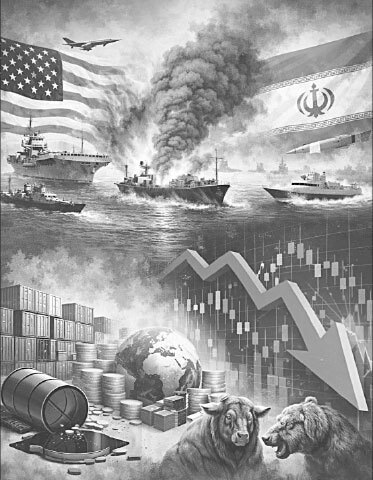
THE present conflict between the United States and Iran is not solely a political issue. It has the potential to endanger regional peace and affect global energy security and maritime trade. The risk for Pakistan is significant. Through the Strait of Hormuz, about 20 million barrels of oil are transported every day which is roughly 20 per cent of the global daily oil consumption.
Over 80pc of the crude oil and LPG passing through Hormuz is destined to Asian markets. Indeed, oil and gas are only two of the many commodities that pass through this particular trade route. Even if the route is blocked temporarily, the impact on world markets would be monumental.
The US has a very visible presence in the Middle East. The Fifth Fleet, which is headquartered in Bahrain, has long been mandated with the role of safeguarding commercial shipping in the Hormuz and the Gulf. On its part, Iran has already voted in parliament to approve the closing of the Hormuz as retaliation against possible American action. The impact of any obstruction will result in a global trade slowdown.
This puts Pakistan at a high risk due to the fact that almost 95pc of its foreign trade passes through the Arabian Sea. Our shipping ports depend on unhindered transit of trade along the Indian Ocean and the Persian Gulf maritime pathways. Disturbances, or even a threat, may cause a sharp rise in the price of fuel and electricity, higher costs of transport and production, and further inflation.
Pakistan needs to have a balanced and neutral policy. It cannot openly ally itself with one of the sides between the US and Iran in order to safeguard trade and energy connections. The need to diversify energy sources is necessary.
Some alternative suppliers of oil that Pakistan can consider in the longer run may include Nigeria, Angola and Brazil.
These sources are not as close in geo-graphical location as the Gulf, but they offer a backup in the event of a long-term disruption. The reliance on a single volatile route is productive in peace, but counter-
productive in such situations. A strategy needs to be devised in line with con-temporary world dynamics.
Maritime security obviously needs to be enhanced based on ground realities. It is also essential to communicate with regional states and maritime information and coordination centres in the region for up-dates to prevent panic and misinformation.
Cdr (retd) Anees Muhammad Khan
Islamabad
Published in Dawn, February 6th, 2026